
The Shopify warranty app for claims, repairs and supplier recovery.
Diagnose, quote and complete repairs — without admin overhead.
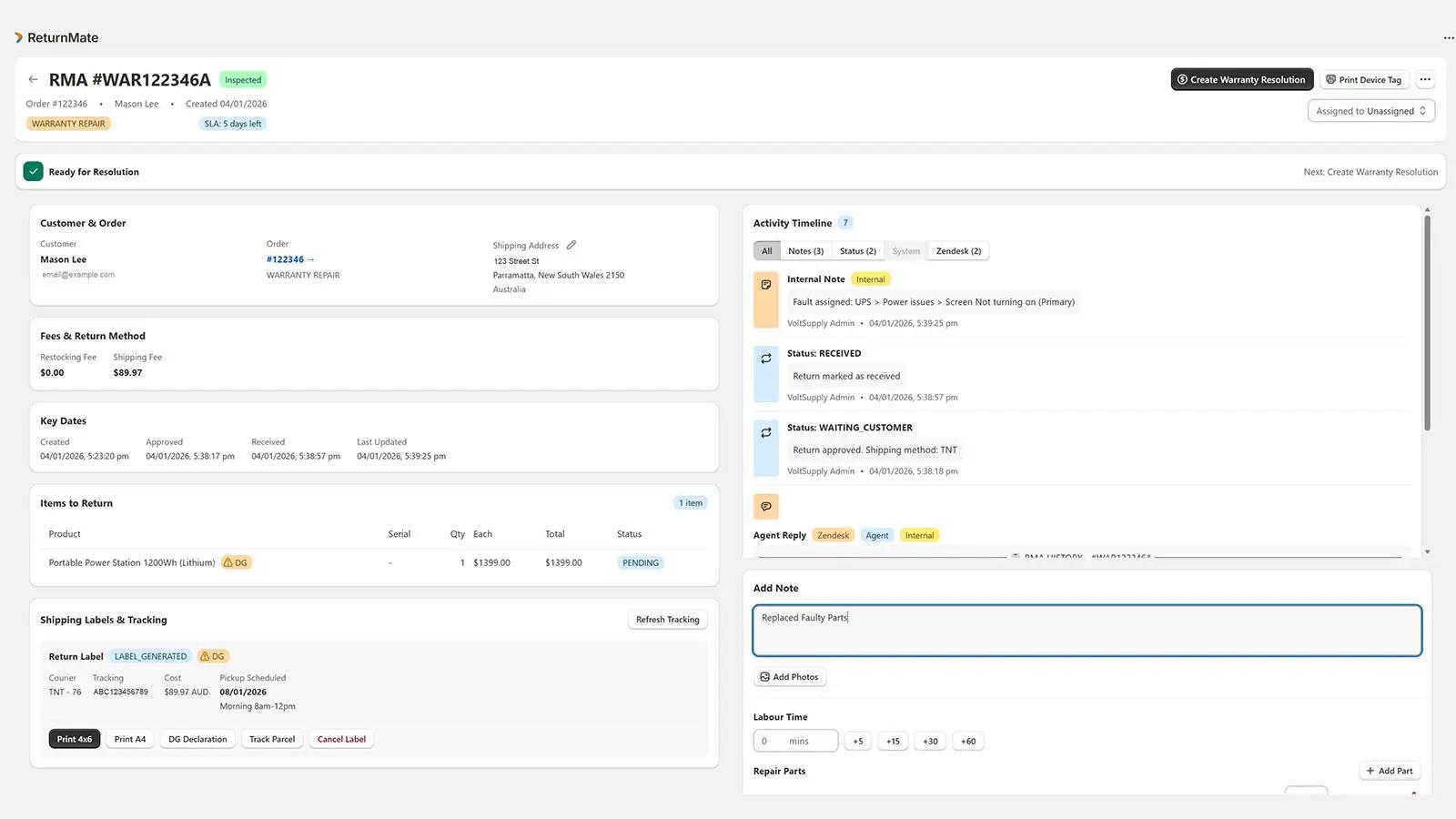
ReturnMate is Shopify warranty and repair management software for merchants that need more than simple replacements. It manages customer warranty claims, serial numbers, evidence, courier returns, technician diagnostics, parts and labour, paid repairs, supplier recovery and quality assurance analytics through the complete product warranty lifecycle.
“It’s simple, easy to use and takes a lot of the hassle out of managing returns.”
A warranty claims app, not an extended-warranty seller.
Two different kinds of app answer to “Shopify warranty app”. ReturnMate is the second kind.
Apps that sell an extended warranty at checkout.
They add a paid protection plan to the cart and pay out when a covered product fails. ReturnMate does not sell plans. A store can run one of those apps alongside ReturnMate; the claim itself still needs a workflow.
Processing the claim when a product comes back.
Coverage check against your own warranty terms, evidence and serial capture, technician diagnosis, repair or replacement, paid out-of-warranty quotes and supplier recovery, on one RMA record next to your everyday returns.
Installs from the App Store, billed through Shopify.
Orders, customers and products sync on install. Refunds and replacement orders are written back to Shopify, the plan is billed on your Shopify invoice, and the free plan includes basic warranty claims and fault codes.
From warranty claim to final resolution.
A warranty claim isn't a return with extra steps. It's evidence capture, an eligibility decision, a return leg, an inspection, a diagnosis, sometimes a quote, a repair, and then the data that tells you whether the supplier should have paid for it. ReturnMate runs all of it on one record.
Self-service portal or staff-created.
Photos, fault description, serial number.
Policy matched on product, SKU, tag or collection.
Label, pickup or depot drop-off.
Scanned in, condition recorded.
Three-level classification, photos, findings.
In-warranty work, or a paid quote.
Minutes logged, stock consumed at cost.
Repaired, replaced or refunded.
Cost attributed, claim evidenced.
Failure rates and cost trends refresh.
ReturnMate manages the full warranty and repair lifecycle inside Shopify. Customers submit claims and evidence, products are returned for inspection, technicians record diagnosis, parts and labour, and each case is resolved through repair, replacement, refund or a paid out-of-warranty quote. The resulting fault and cost data flows into supplier recovery and product-quality reporting.
Built for merchants selling electronics, appliances, tools, machinery, mobility and lithium-powered products — anything where a warranty claim means an inspection rather than a refund button. Running a repair counter for walk-in or booked-in customers as well? Counter intake, repair jobs and online repair bookings are on repair management.
Stop checking warranty coverage manually.
Automatically determine whether a claim is covered using warranty rules tied to Shopify products, SKUs, tags and collections. Your team stops digging through order dates and supplier PDFs to answer a question the system already knows.
- Policies vary by product ID, SKU, tag or collection — a 2-year appliance and a 5-year tool coexist
- Consumables and wear items excluded by rule, not by memory
- Coverage window calculated from Shopify purchase date, or a supplied proof-of-purchase date
- Serial number verification at claim time, enforced against active RMAs
- Goodwill decisions still possible — but recorded as goodwill, with who approved it
- Determination written to the RMA, so the reason is auditable months later
Customer warranty claims without email chains.
The claim starts with the customer, not your inbox. A branded self-service portal collects the evidence a technician actually needs — before anyone on your team opens a ticket. If support works in Gorgias, the Gorgias warranty integration puts the claim's status on the ticket and keeps the conversation in step.
- Self-service warranty submission on your own domain and branding
- Order lookup so the claim attaches to the real Shopify order
- Photo and video evidence uploaded at submission
- Serial number capture and verification
- Structured fault description, not a free-text essay
- Policy and eligibility checks run before staff see it
- Claim status visible to the customer throughout
- Customer communications sent from the RMA, logged against it
The result is a complete package on arrival — not a five-email back-and-forth to establish what broke and when it was bought.
Turn technician findings into product intelligence.
Most systems store a free-text "reason". ReturnMate stores a three-level classification against every diagnosis — so a technician's finding becomes queryable data instead of a note nobody reads. It works the same way for an appliance, a power tool or a battery pack.
Confirmed failures on this SKU in 90 days — above the 5% threshold.
Eleven of fourteen share supplier batch PW-2409.
Warranty labour and parts attributable to that batch.
- Customer-reported fault kept separate from technician-confirmed fault
- Fault severity levels, so a cosmetic scuff doesn't rank with a functional failure
- Diagnostic findings, photos and serial verification attached to the job
- Failure-rate thresholds per SKU, with alerts when a product crosses them
Know the true cost of every warranty claim.
Combine return shipping, technician labour, parts consumed, replacement cost and other resolution costs to understand the true cost of warranty by SKU, fault type and supplier. Once every job carries its real cost, repair-or-replace stops being a hunch.
- Assign jobs to technicians, or let them claim from an unassigned queue
- Labour logged in minutes against your configured rate
- Parts consumed at cost, drawn against stock
- Inbound and outbound freight attributed to the claim
- Replacement cost counted when a unit can't be repaired
- Cost-to-repair per job, per SKU and per fault subcategory
- In-warranty cost separated from paid repair revenue
Third-party workshops work the same way — send the unit out, track it as an external repair, and keep the cost on the same record.
Turn out-of-warranty repairs into paid work.
Inspection complete? Build a repair quote in ReturnMate. The customer receives a Shopify checkout link and pays using the payment methods they already trust. Once payment clears, the RMA moves straight back into the repair queue.
Inspect
Technician diagnoses and classifies the fault.
Quote
Labour and parts priced into a repair quote.
Shopify checkout
Customer pays with the methods your store already accepts.
Paid
Payment confirmed against the RMA automatically.
Repair
Job returns to the technician queue, funded.
- Quotes built from your labour rate and real parts cost, not guessed
- Sent as a Shopify checkout — no invoicing system, no bank transfer chase
- Expiry window on every quote, so stale jobs don't hold bench space
- Declined quotes route to return-as-is or disposal, with the decision logged
- Payment reconciles against the RMA and the Shopify order automatically
- Out-of-warranty work becomes a revenue line, reportable like any other
Turn verified product faults into supplier accountability.
Track which supplier, SKU and fault type is responsible for a warranty case, group defective products for return-to-vendor workflows, and keep the evidence needed to pursue supplier credits, warranty recovery or chargebacks.
- Link verified faults to SKU, batch and supplier
- Separate customer-reported faults from technician-confirmed faults
- Track supplier-responsible warranty costs, not just unit counts
- Group defective units for supplier and return-to-vendor processing
- Export fault and warranty evidence for supplier claims
- Track credits and recovery against the original warranty cost
- Analyse supplier defect rates over time
A supplier can argue with an anecdote. They can't argue with eleven technician-confirmed diagnoses on one batch, costed to the minute.
Find the products, faults and suppliers creating your warranty cost.
Every technician diagnosis becomes structured quality data. ReturnMate rolls verified faults into SKU-, product- and supplier-level trends so warranty teams can identify repeat failures, manufacturing issues and rising repair costs.
BMS FAILURE14
CHUCK WEAR9
CONTROL BOARD6
FRAME DAMAGE5
INSULATION SCUFF3
- Failure rate by SKU, with repeat-failure thresholds you set
- Fault category and subcategory trends over time
- Customer-reported versus technician-confirmed faults
- Average repair cost by product and by fault type
- Labour and parts cost trends
- Supplier defect rates, month over month
- Exportable reporting for manufacturers and suppliers
- Warranty cost by SKU, fault type and supplier in one view
This is the reporting layer behind returns analytics and fault tracking — the same data, framed for a quality conversation rather than an operational one.

Take the repair workflow to the bench.
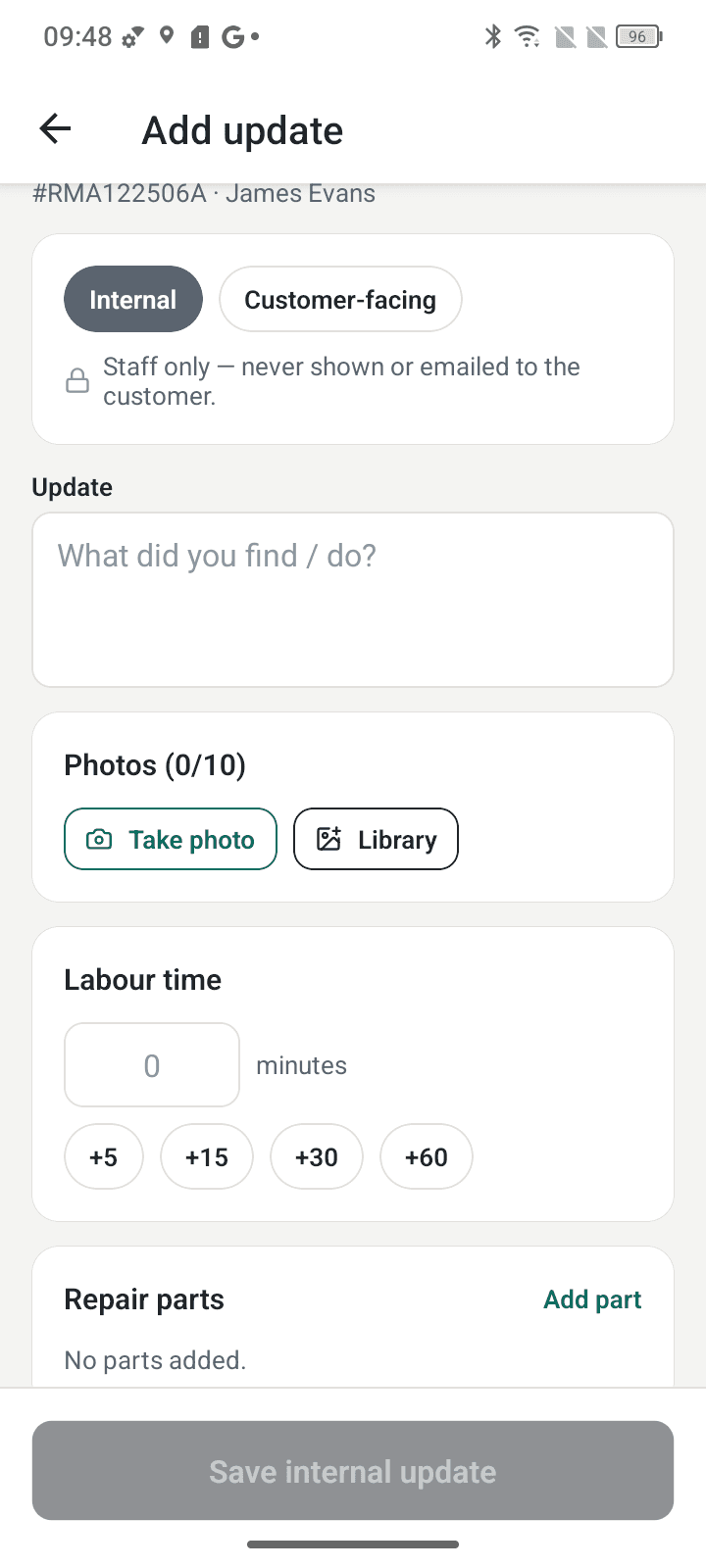
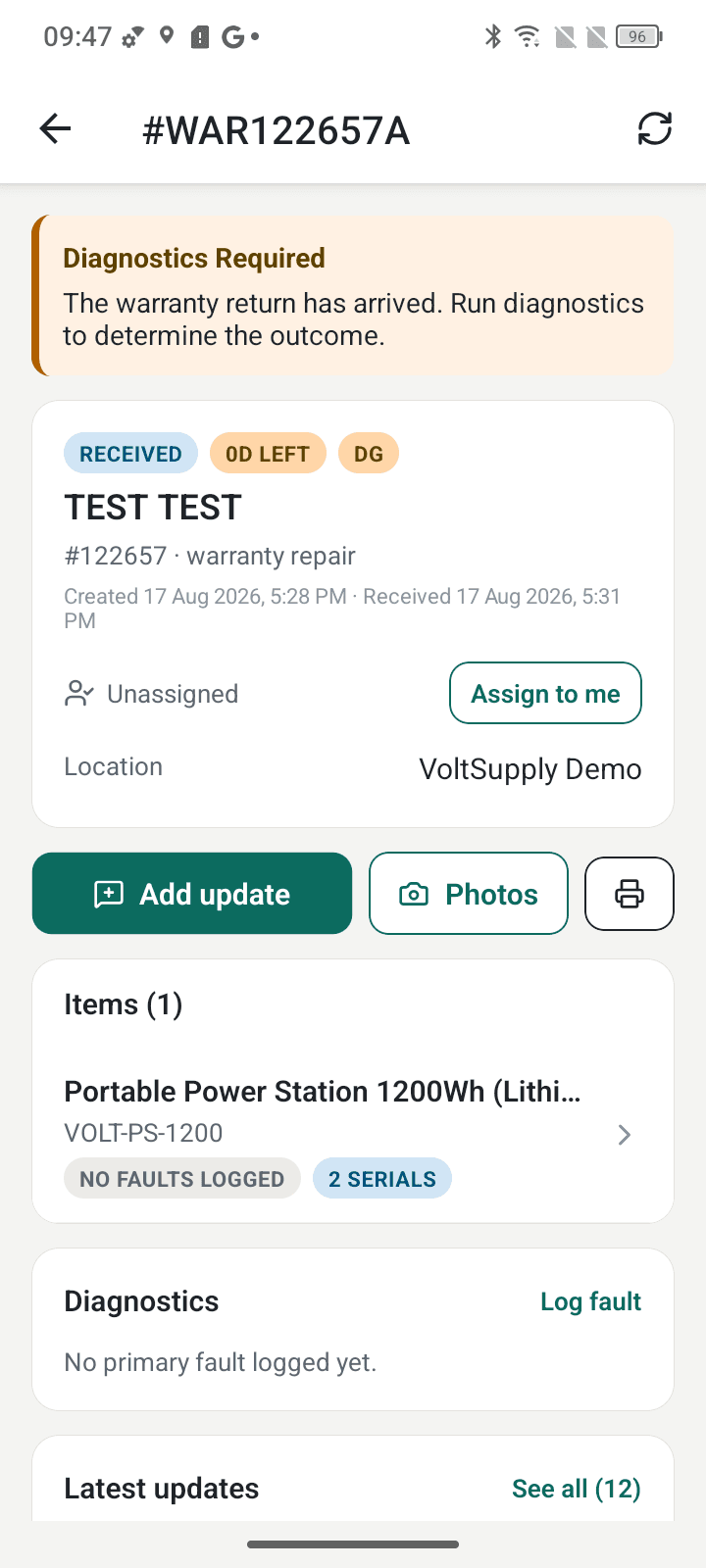
A purpose-built technician app for receiving units, scanning RMAs, running diagnostics, capturing photos, recording serial numbers, labour and parts, and completing repair work from the workshop floor.
- Scan a device tag, QR or carrier label to open the right job
- Log faults and diagnostic findings where the work happens
- Record labour minutes and parts consumed as you go
- Writes to the same RMA the office is looking at, instantly
What changes on day one.
Most warranty operations aren't badly run — they're run across email, a spreadsheet and someone's memory. Here's what moves into one system.
What the warranty app costs.
Plans are priced on RMA volume, not order volume, and a warranty claim or repair job counts as one RMA. Prices in USD a month, billed through Shopify.
| Plan | USD / month | RMAs included | Warranty & repairs |
|---|---|---|---|
| Free | $0 | 5 | Basic claims + fault codes |
| Returns | $29 | 200 | No (returns only) |
| Starter | $49 | 50 | Yes |
| Growth | $299 | 250 | Yes |
| Ops | $599 | 500 | Yes |
| Scale | $1,349 | 1,000 | Yes |
| Enterprise | $2,500 | Unlimited | Yes · contact sales |
Full plan features, the volume estimator and add-ons are on the pricing page. Shopify-billed plans can be started and cancelled from the Shopify admin.
Warranty and repair questions.
What is warranty management software?
Warranty management software handles the lifecycle of a warranty claim: capturing the claim and its evidence, determining whether the product is covered, verifying serial numbers and proof of purchase, running the inspection and diagnosis, deciding between repair, replacement or refund, tracking parts and labour, and reporting the resulting cost back to the business and its suppliers. ReturnMate is warranty management software for Shopify merchants. It covers the whole lifecycle — customer claim, courier return, warehouse receipt, technician diagnosis, repair or replacement, paid out-of-warranty work, supplier recovery and quality assurance analytics — on a single record connected to your Shopify orders and products.
Can ReturnMate manage warranty claims in Shopify?
Yes. Customers submit warranty claims through a branded self-service portal that looks up their Shopify order, captures the serial number, fault description and photo evidence, and runs your warranty policy to determine eligibility before your team sees the claim. Staff can also create claims directly. Every claim is a record connected to the Shopify order, product and customer.
Is ReturnMate a Shopify warranty app or an extended-warranty app?
A warranty claims app. ReturnMate processes the claim when a product fails: coverage check against your own warranty terms, evidence and serial capture, diagnosis, repair or replacement, paid out-of-warranty quotes and supplier recovery. It does not sell extended warranties or protection plans at checkout. Stores that use a protection-plan app can run it alongside ReturnMate, which then handles the claim workflow.
Can ReturnMate manage product repairs as well as replacements?
Yes — repairs are a first-class workflow, not an afterthought. Jobs are assigned to technicians or claimed from a queue. Technicians record a three-level fault classification, diagnostic findings, photos, serial verification, labour in minutes and parts consumed at cost. The job resolves as a repair, a replacement, a refund, a rejection or a paid out-of-warranty quote, and every outcome is logged with its cost. For repair shops and service counters, the repair modules add counter intake with customer consents, a stage-driven job page, device password storage and online repair bookings (see ReturnMate's repair management page).
Can ReturnMate track supplier warranty claims and returns?
Yes. Verified faults link to SKU, batch and supplier, so warranty cost is attributed to whoever caused it. Defective units can be grouped for supplier and return-to-vendor processing, supplier-responsible cost is tracked across labour, parts and freight rather than unit counts alone, and the fault and warranty evidence exports for a supplier claim. Credits and recovery are tracked back against the original warranty cost, and supplier defect rates are reportable over time.
Does ReturnMate provide warranty and quality assurance analytics?
Yes. Because every diagnosis is stored as structured data rather than free text, ReturnMate reports failure rate by SKU, fault category and subcategory trends, customer-reported versus technician-confirmed faults, average repair cost by product and fault type, labour and parts cost trends, supplier defect rates and month-over-month quality trends. Repeat-failure thresholds per SKU raise an alert when a product crosses a limit you set, and reporting exports for manufacturers and suppliers.
Can I track serial numbers through a warranty repair?
Yes. Serials are captured at claim time, verified again when the unit is received, and enforced for uniqueness across active RMAs — so the same unit can't be claimed twice, and the unit on the bench is provably the unit that was claimed. Claims without a serial can still be submitted, but they're flagged for staff review.
Can customers submit photos and evidence with warranty claims?
Yes. The self-service portal collects photo and video evidence, the serial number and a structured fault description at submission, so the claim arrives as a complete package. Evidence attaches to the RMA and is visible to the technician who eventually opens the unit.
Can I charge customers for out-of-warranty repairs?
Yes. After inspection you build a repair quote from your labour rate and real parts cost, and the customer receives a Shopify checkout link — paying with the methods your store already accepts. When payment clears, the RMA moves back into the repair queue automatically. Quotes carry an expiry window, and declined quotes route to return-as-is or disposal with the decision logged.
What kinds of products is this built for?
Merchants selling electronics, appliances, tools, machinery, mobility products and lithium-powered goods — anything where a warranty claim means an inspection, a diagnosis or a repair rather than a refund and a restock. ReturnMate also handles the dangerous goods side when a returned product carries a hazard classification, but the warranty and repair workflow is the same whether dangerous goods are involved or not.
How do I install the warranty app on Shopify?
Install ReturnMate from the Shopify App Store. Orders, customers and products sync on install and the app runs inside the Shopify admin. Standard returns can run the same day; warranty terms, fault codes and technician workflows are configured step by step after that. Billing is through Shopify, and the plan can be changed or cancelled from the Shopify admin.
Does the free plan include warranty claims?
Yes. The Free plan (US$0 a month, 5 RMAs) includes basic warranty claims with fault-code logging and a basic repair workflow alongside standard returns. The Returns plan is the exception: it is a returns-only tier without warranty or repair. Full warranty and repair workflows, serial tracking, helpdesk sync and analytics start on Starter.
How much does ReturnMate warranty management cost?
ReturnMate has a Free plan at $0/month including 5 RMAs. Starter is $49/month for up to 50 RMAs, with Growth, Ops, Scale and Enterprise plans available for larger operations. Billing runs through Shopify, and you can cancel from inside Shopify.
Comparing tools before you install anything? The vendor-neutral warranty management software guide covers the three categories of tool, the seven core capabilities and what they cost, and the Shopify warranty management guide walks a claim from intake to supplier credit.
Related capabilities.
Every RMA tracked. Every decision logged.
Twelve workflow types, per-item resolution, business-hour SLA and a finance-ready audit trail across every return, claim and repair.
Read more →§ GUIDEShopify warranty management: the practical guide.
How to run a claim from intake to supplier credit, which kind of app fits, where margin leaks and the Australian Consumer Law obligations.
Read the guide →§ REPAIR MANAGEMENTRun a repair counter and bench.
Counter intake with consents and spend limits, stage-driven repair jobs, estimates, device passwords, collection checks and online repair bookings.
Read more →Warranty work you can measure, recover and charge for.
See the full claim-to-resolution workflow on your own products. Billed through Shopify, cancel from inside Shopify.