
RMA management for Shopify — from return request to final resolution.
A single system of record for every return, warranty claim, counter swap and repair — with the audit trail your finance, compliance and ops teams all need.
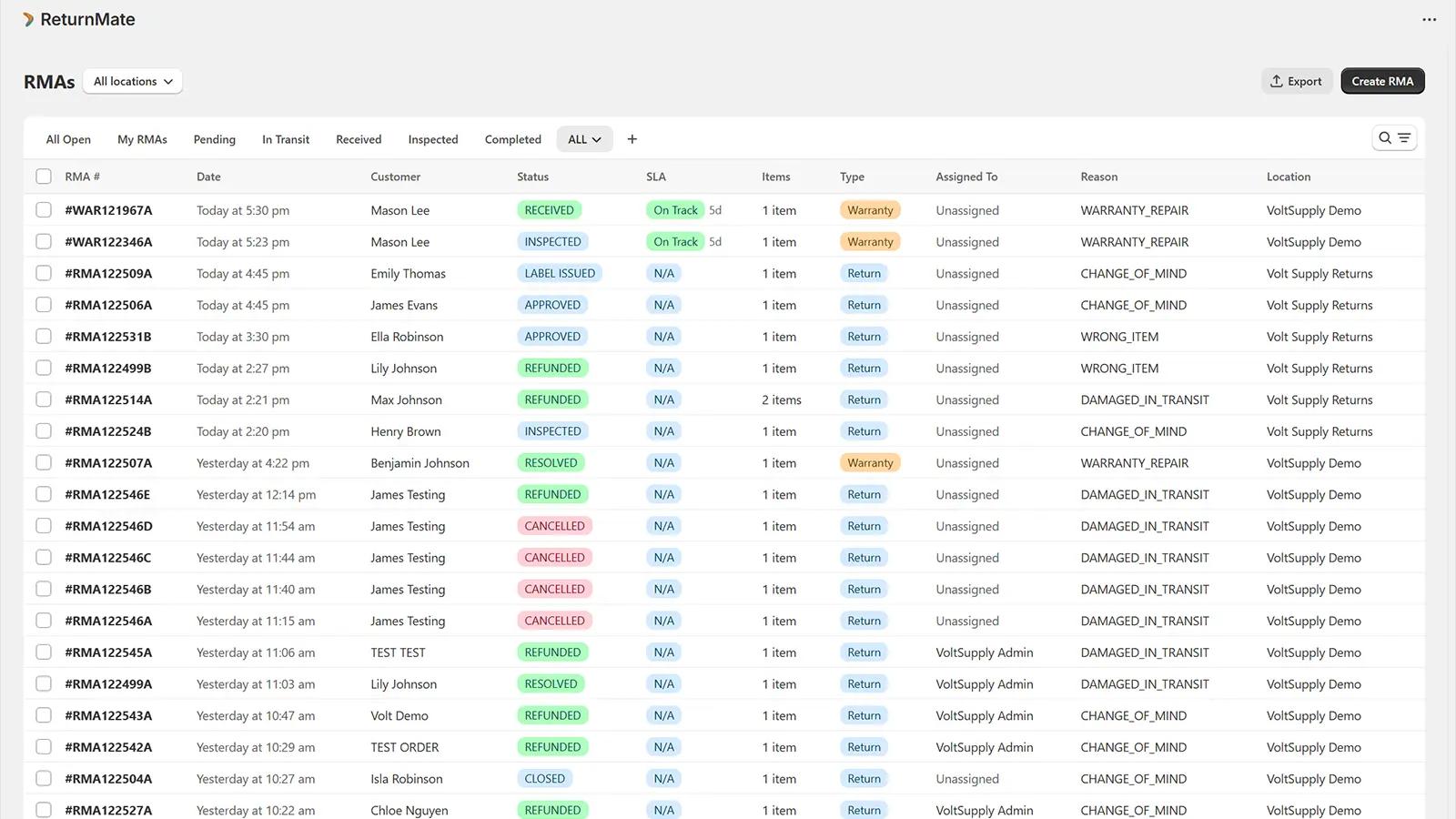
The record that follows the unit, not just the refund.
RMA management software tracks a product from the moment a customer requests a return or warranty claim through approval, shipping, receiving, inspection, repair, replacement, refund or supplier resolution. For Shopify merchants, it connects the customer order to the operational work that happens after the return is authorised.
ReturnMate manages that full lifecycle in one RMA record, including standard returns, warranty claims, repairs, fault diagnosis, replacement orders and supplier outcomes — Shopify-native, connected to the original order.
Started, not submitted.
Customer or staff request in.
Rule fired, or a human decided.
Carrier picked, DG checked.
Tracking attached.
Scanned into a location.
Condition and fault recorded.
Refund, replace, repair, write-off.
- Custom status codes per shop, colour-coded in the admin list
- Transitions emit timeline entries automatically; manual notes at any step
- Line items resolve independently while the parent RMA stays open
- Per-status SLA targets attach to any state, default or custom
Twelve workflows. One reporting surface.
Different states and different enforcement rules per type — but the same underlying RMA record, so a warranty claim and a counter swap land in the same report without a mapping exercise. Standard returns, warranty claims, internal and third-party repairs, replacements, supplier returns and customer refunds all remain attached to the same RMA record.
Warranty and repair stay inside the RMA.
A warranty claim isn't a different system — it's an RMA with more stages. ReturnMate runs the claim from eligibility and serial verification through receiving, technician diagnosis and fault coding, parts and labour capture, a paid repair quote where the work is out of warranty, and a repair, replacement or rejection — with supplier recovery raised where the fault is the supplier's to fund.
Decision rules your team actually follows.
Auto-approval fires when a return matches defined conditions. Everything else routes to a queue where a human approver sees the full history inline — so the exception is the thing that gets attention, not the routine.
- Rules evaluated at submission and again at inspection
- Restocking fees per condition — good, fair, damaged, unusable
- Rejection reasons captured as structured codes for reporting
- Disputes flag on any RMA: SLA pauses, closure blocks until a manager resolves
Business hours, not calendar hours.
SLA calculation respects Australian public holidays, so a claim submitted 4pm Friday of a long weekend isn't breached by Tuesday morning. Staff see their queue at login; managers see at-risk and breached work across every shop.
- Per-status SLA targets — approve within 1 business day, inspect within 2
- Breach and near-breach notifications by email and in-app
- Saved views per user, shareable, scoped to location or assignee
- Bulk approve, bulk send label, bulk mark-received from any list
One RMA can end three different ways.
Refund one line, replace another, write off a third — each with its own disposition, each logged separately, with the parent RMA staying open until every item lands somewhere.
Every RMA becomes product-quality data.
Resolving the customer's problem isn't the end of the RMA's value. Because every stage writes structured fields to the same record, the RMA doubles as a quality observation: what failed, who confirmed it, what it cost to fix, and whether the supplier funded it.
Over time, that turns operational RMA data into failure-rate, supplier-quality and warranty-cost reporting — the numbers behind supplier fault tracking and returns analytics.
Finance-ready, not best-effort.
Every status change, admin note, refund and Shopify order tag logged against the RMA with the staff member, timestamp and before/after values. Export any filtered list for finance, compliance, supplier warranty claims, quality reviews and credit recovery.
- An AuditLog entry for every mutation — created, approved, refunded, tagged
- Timeline entries with user attribution for the merchant-visible trail
- Webhook events pushed to external systems for real-time downstream sync
- CSV export of any filtered list, at any time
Questions about RMA management.
What is RMA management software?
RMA (return merchandise authorisation) management software tracks a product from the moment a customer requests a return or warranty claim through approval, shipping, receiving, inspection, repair, replacement, refund or supplier resolution. It gives every returned unit a single record — the RMA — that carries its status, history, costs and final outcome, so operations, customer service and finance work from the same information.
Does Shopify have RMA management built in?
Shopify provides native return, refund and exchange capabilities. RMA management becomes useful when a return requires additional operational stages such as receiving, inspection, warranty assessment, technician repair, supplier recovery, SLA tracking or detailed audit history. ReturnMate adds those stages as a Shopify-native app, connecting each RMA back to the original Shopify order.
What's the difference between an RMA and a standard Shopify return?
A standard Shopify return is a refund or exchange against an order. An RMA is an operational record that follows the physical unit: it can carry serial numbers, inspection results, fault codes, technician time, parts, freight, restocking fees, supplier outcomes and an audit trail — and it can end in repair, replacement, write-off or supplier recovery, not just a refund.
Can ReturnMate manage warranty claims and repairs?
Yes. Warranty claims, internal (offline) repairs and third-party repairs are three of ReturnMate's twelve workflow types. A warranty RMA runs from eligibility and serial verification through receiving, technician assignment, diagnosis and fault coding, parts and labour capture, repair or replacement, and — where the fault is a supplier's responsibility — supplier recovery.
Can an RMA include parts and labour costs?
Yes. Technicians record labour time and parts consumed against the RMA as they work, alongside diagnostic findings and photos. Out-of-warranty work can be quoted and paid through Shopify checkout, and repair costs roll up into warranty-cost and supplier-recovery reporting.
Can ReturnMate track supplier returns and warranty recovery?
Yes. Faults are classified and logged against the SKU, serial, batch and supplier, and a write-off or repair can raise a supplier charge-back. The audit log keeps the evidence — condition, fault code, technician findings, before/after values — so supplier warranty claims and credit recovery are argued from records, not memory.
Can I customise the RMA status flow?
Yes. The default statuses cover most flows, but you can add custom status codes per shop — AWAITING_SUPPLIER_CREDIT, for example — with colour labels and their own SLA targets. Existing RMAs keep working through transitions.
Does per-item resolution mean one RMA can have mixed outcomes?
Exactly. Refund item A, replace item B and write off item C on the same RMA, each with its own disposition. The parent RMA stays open until every item is resolved, and each outcome is logged and reported separately.
How are duplicate returns prevented?
Serial number uniqueness is enforced at product level across active RMAs — a serial already in an open return can't be submitted again. Customers without a serial can still submit, but the request is flagged for staff review.
What happens to the SLA clock when a return is disputed?
It pauses. Flagging a dispute on an RMA stops the SLA countdown and blocks closure until a manager resolves it, so disputed work doesn't quietly show as breached in your team's metrics.
Do the workflow types report separately or together?
Both. Every type shares one RMA record, so you can report across all post-sale activity at once, or filter to a single workflow — warranty claims only, counter swaps only — without reconciling different data shapes.
Related capabilities.
RMA status on the support ticket.
The Gorgias warranty and returns integration: RMA details in the ticket sidebar, a ticket for every new return, and messages and notes synced both ways.
Read more →§ CUSTOMER PORTALCustomers self-serve. Your team handles exceptions.
A branded portal that captures structured evidence, verifies identity and validates addresses — before your team ever touches the RMA.
Read more →§ WARRANTY & REPAIRSDiagnostics, technician queues and paid repair quotes.
The deep dive on the warranty and repair capability this page's lifecycle runs through — fault classification, labour tracking and quotes paid via Shopify checkout.
Read more →Get operational control — before it costs you more.
Start free — 5 RMAs/month included. Returns-only from $29/month; returns, warranty and repairs from $49/month. No credit card required. Billed through Shopify.