
Which Shopify returns app is best?
There is no single best Shopify returns app for every store, because a Shopify returns and exchanges app built for apparel and a returns platform built for warranty repairs are solving different problems. Loop is strongest for exchange-led fashion and lifestyle returns; AfterShip fits broad ecommerce and merchants already using its post-purchase stack; Narvar targets larger multi-channel brands; and ReturnMate is built for merchants whose returns involve warranty, repair, fault diagnosis or dangerous goods. The right choice depends more on the shape of your return workflow than on the size of your store — and the rest of this guide exists to help you work out which workflow you actually run. If your returns are mostly warranty claims, the warranty management guide is the better starting point; if they involve lithium or other regulated goods, start with dangerous goods returns in Australia.
We don't rank ReturnMate as the best option for every merchant. Capabilities are assessed against each platform's public documentation, Shopify App Store listing and published feature set, and each vendor entry links to the sources we checked. App cards last verified 23 August 2026 (AfterShip 8 September 2026); shortlist pricing checked 8 September 2026.
The Shopify returns app landscape
There are roughly 30 returns apps actively listed on the Shopify App Store as of 2026, plus a long tail of older or single-merchant tools. Almost all of them give the customer a branded return portal and the merchant a queue of requests; where Shopify returns software differs is in what happens after the request is approved. Most of the volume — and most of the noise — comes from a half-dozen well-funded vendors competing for the same mid-market install base.
The market splits cleanly into four categories, even if the apps themselves don't always position that way. The right category for you depends entirely on what you sell.
High-volume exchange logic, dynamic merchandising on the return, brand-led portal experience.
Shopify-native, broad ecommerce, cost-conscious. The largest and most crowded segment.
Returns plus tracking plus marketing, usually multi-platform and multi-channel.
Warranty workflows, dangerous goods, repair-heavy categories, supplier accountability.
| Capability | AFashion & lifestyle15–30% rate | BGeneralist mid-market5–15% rate | CEnterprise post-purchaseMulti-platform | DRegulated & repair-heavy1–5% rate |
|---|---|---|---|---|
| Exchange & store-credit merchandising | Strong | Partial | Strong | Partial |
| Warranty & repair depth (diagnostics, labour, quotes) | Partial | Partial | Partial | Strong |
| Dangerous goods & ADG documents | Limited | Limited | Limited | Strong |
| Per-SKU & supplier fault attribution | Partial | Partial | Partial | Strong |
| Multi-platform / OMS integration | Limited | Limited | Strong | Limited |
| In-person & in-store returns | Limited | Partial | Partial | Strong |
| B2B / trade account returns | Limited | Limited | Partial | Strong |
| Scales to 1,000+ RMAs a month | Strong | Partial | Strong | Strong |
Five buying personas
Most evaluation guides skip this step and jump straight to feature comparisons, which is what makes them generic. The real first question is which of these personas describes your operation. The right app for one is wrong for another — not because of feature gaps but because of fundamental design assumptions.
The fashion / lifestyle volume merchant
Apparel, accessories, beauty, home goods. Exchange-heavy resolutions where brand experience matters more than warehouse cost optimisation.
The generalist Shopify SMB
Broad ecommerce mix, cost-conscious, wants Shopify-native, GDPR-clean and simple. The biggest segment by merchant count and the most contested.
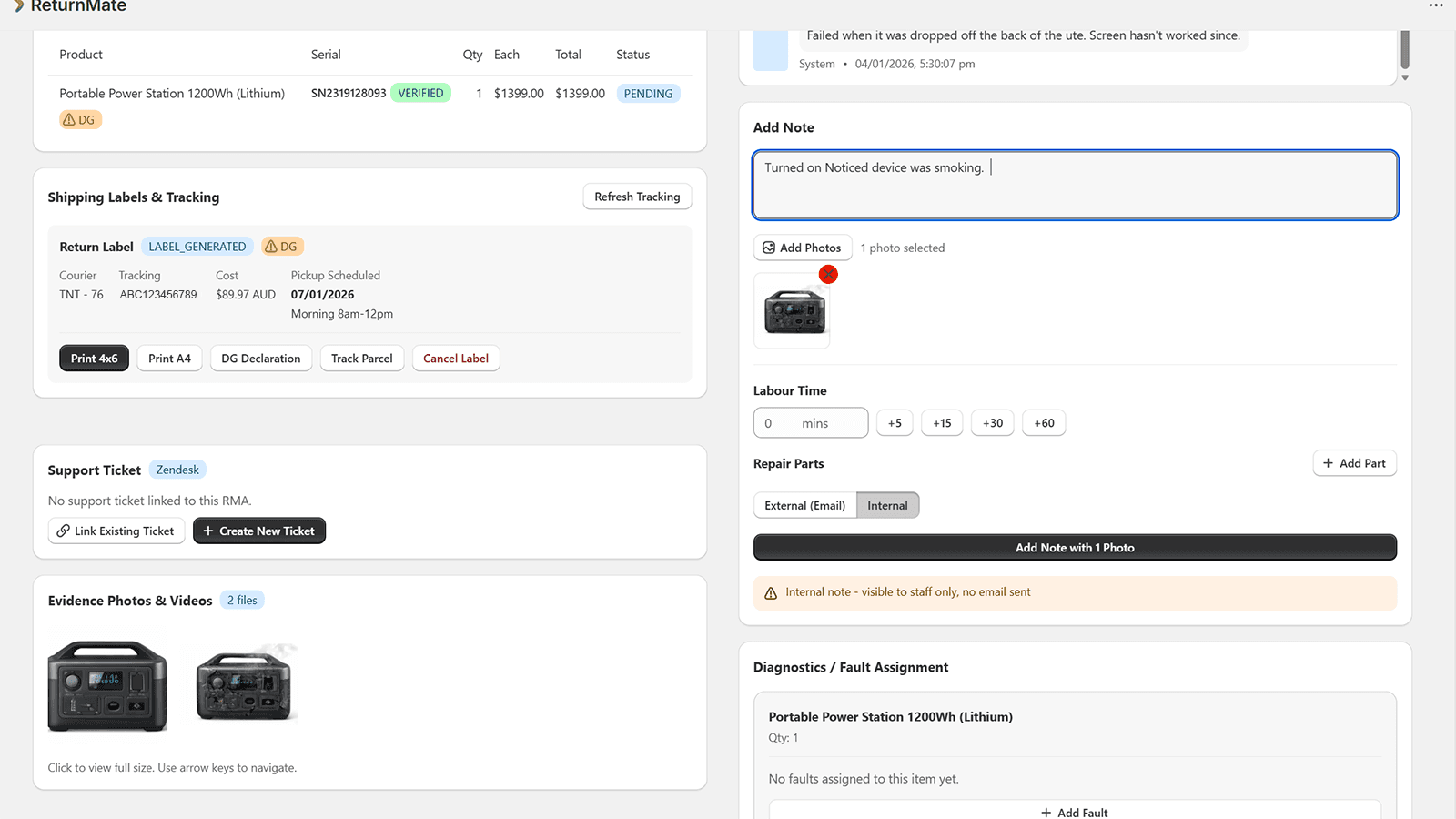
The repair-heavy / regulated merchant
Electronics, appliances, watches, e-bikes, lithium-powered devices, dangerous goods. Lower volumes but far higher complexity per return — warranty workflows, fault diagnostics, repair quotes, ADG transport documents.
The enterprise multi-channel brand
Established retail brand, $50M+ revenue, international, multi-platform across Shopify Plus, retail and marketplaces. Needs returns, tracking and post-purchase marketing in one contract.
The B2B / wholesale merchant
Trade orders, account credits, supplier returns. The standard ecommerce model — refund to original payment method — simply doesn't fit. Few apps handle this natively; most merchants combine a returns app with a B2B platform like TradeMate.
The major apps at a glance
What follows is a short, neutral characterisation of each major Shopify returns app. The goal isn't to rank them — it's to give you enough to decide which is worth a deep evaluation for your specific case. Every entry gets the same treatment: what it's good at, and what to check with the vendor before choosing it. The shortlist table at the top links to each entry.

Loop Returns
Category AThe market leader for fashion and lifestyle. Best-in-class exchange flow, instant store credit, dynamic upsells on the return page, and a strong brand experience on the customer portal. For apparel it pays for itself in upsell conversion.
Ask how a warranty or repair return is modelled beyond the exchange flow, whether it produces dangerous-goods transport documents, and what the per-return cost is at your volume on the Essential and Advanced tiers. Confirm Checkout+ eligibility before counting on the free plan.

AfterShip Returns
Category B / CThe integration story. Part of AfterShip's broader post-purchase platform — if you already run AfterShip Tracking, returns slots in cleanly with the same admin and customer experience. The Premium plan adds a warranty portal and warranty dashboard, so warranty claims can be captured inside the same tool.
Ask what happens after a warranty claim is accepted: technician assignment, labour and parts, paid repair quotes and supplier recovery, and which plan each sits on. Ask whether it produces dangerous-goods transport documents for your market. Confirm what Essentials includes before the per-return charge applies.

ReturnGO
Category BSolid exchange and refund logic, AI-driven return reason classification, and a fair price point. Strong content presence — punches above its weight for mid-market operations.
Ask which automation, ERP integration and API features sit on Premium versus the higher tiers, what the per-return charge is past the 110 included at your volume, and for references at your scale.

Return Prime
Category BValue tier done properly. Affordable, simple, covers the basics well, with broad SMB adoption particularly outside the US.
Ask what the Start tier includes at $0.49 per request versus the paid tiers, how deep the analytics and portal customisation go, and which carriers it connects in your market.

Rich Returns
Category BSimilar positioning to Return Prime — Shopify-native, mid-market focus, fair price, clean coverage of the basics.
Ask which tier includes international labels and API access, what the per-return cost is past the 10 included, and how far the portal and analytics can be customised.

Narvar
Category CEnterprise post-purchase platform — returns alongside tracking, OMS integration and marketing, with a strong brand-name customer list.
Ask what the Free Shopify listing actually covers and what the platform contract costs in total. If you are Shopify-only, ask which of the multi-platform capabilities you would be paying for.

Happy Returns
Category BThe physical drop-off network — US customers can return at retail locations without a box or label. A genuine structural differentiator for US merchants.
Ask whether the Return Bar network operates in your market, what portal and logistics charges apply, and what the software offers on its own where drop-off is not available.

ReturnMate
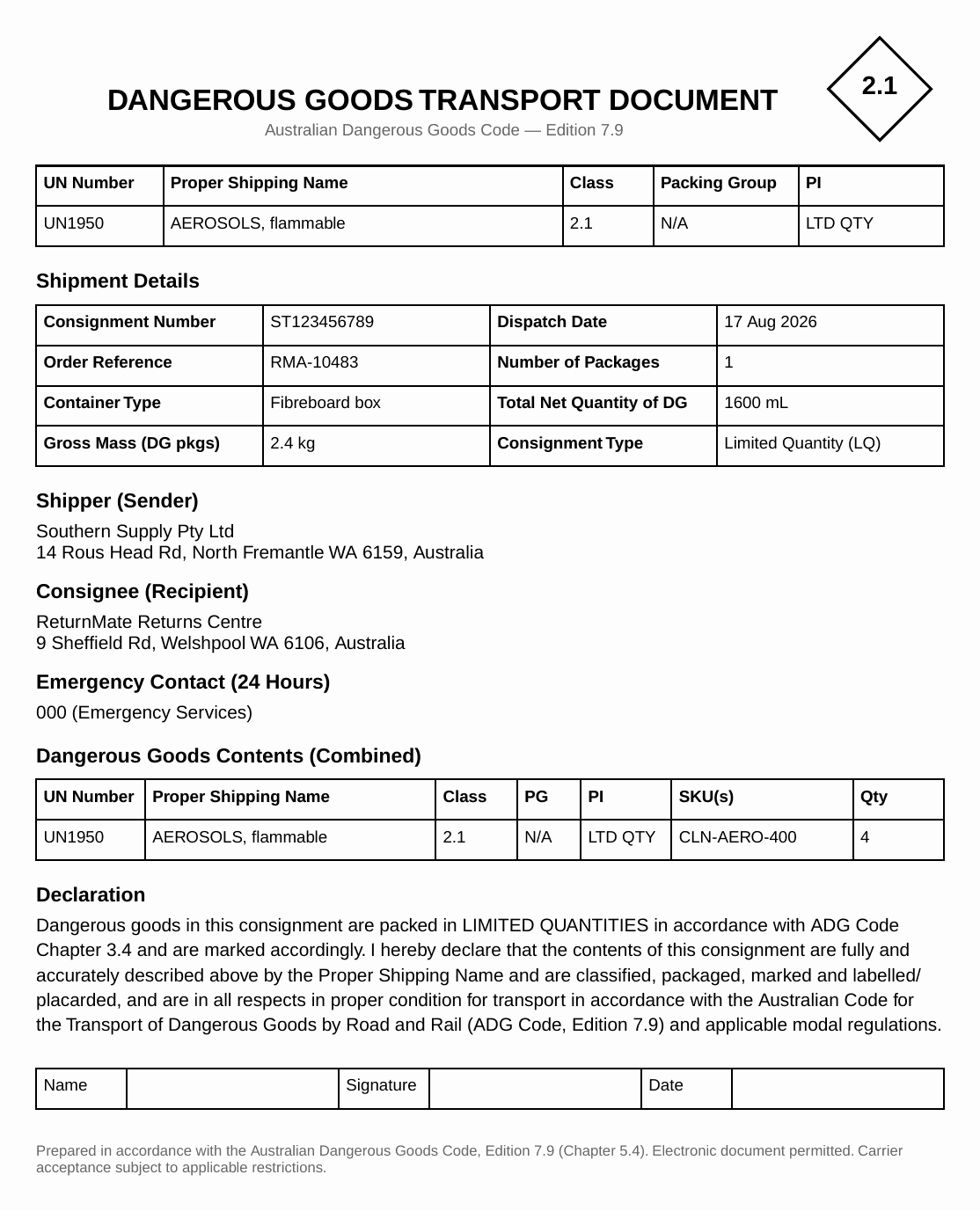
Category DBuilt for the regulated, repair-heavy case in persona 3. Warranty workflows, three-level fault codes, paid repair quotes through Shopify checkout, transport documents prepared to the ADG Code (Edition 7.9), counter swap for in-person and in-store returns, multi-store hub-and-spoke transfers, and B2B trade returns via TradeMate.
Test the full journey from warranty claim to technician diagnosis, parts and labour, paid repair and supplier recovery. That is the distinction from a warranty checkbox on a returns plan, and it is only worth paying for if your returns involve it: pure change-of-mind merchants will not use most of it. Check the Free plan's 5 RMAs and the $2 per RMA beyond that against your volume.
ReturnMate's own entry is documented in more depth than a card allows: the features hub, the ten industries it is built for, and pricing — seven tiers from a free plan, including a returns-only tier, in USD, billed through Shopify.
Comparison criteria worth asking about
Feature lists from vendor demo pages tend to read identically. The criteria that separate apps in practice are operational, not feature-level. When you're shortlisting, push on these specifically.
- How does the app handle workflow types other than change-of-mind?
If it can't model warranty, repair, or DG returns as first-class workflows, it'll force you to bolt on second tools later.
- What happens to in-flight RMAs if I uninstall?
Some apps lose data on uninstall; others archive it. Critical for compliance and supplier credit reconciliation.
- How does the refund actually flow into Shopify?
Refunds via the Shopify Returns API show correctly in the Shopify order; refunds via legacy methods often look like "refunded externally" with no line-item attribution.
- Is the Shopify Billing integration real or a token?
Real Shopify Billing means uninstall handling, plan upgrades, and decline flows are all native. Some apps charge externally with a Shopify-side dummy plan.
- Are mandatory GDPR webhooks honoured?
Customer data requests, customer redact, shop redact — if these aren't handled in the platform, your store fails the App Store compliance review.
- What's the carrier story?
Does the app offer rate-shopping across carriers, or is it locked to one (often the vendor's own preferred partner)? Single-carrier tools work for US-based simple cases and break for AU, EU, or DG-aware merchants.
- What's the analytics depth?
Aggregate dashboards are easy; what matters is per-SKU return rate, cost decomposition, fault-block reporting, and supplier credit ledgers.
Migration risks and considerations
Switching apps is more common than vendors admit. The triggers are usually predictable: hitting a workflow ceiling, needing dangerous-goods support, growing into multi-store operations, or aggressive price hikes from the incumbent.
The migration itself is straightforward to execute but carries real risks. Historical RMA migration is rarely one-click: platforms use different data models for return reasons, statuses, evidence, shipping records and resolution outcomes, so migrations usually require custom mapping and some historical fields may not transfer cleanly.
A common approach is to retain read-only access to the previous system until open cases are resolved and historical records have been archived. Budget for the overlapping subscription — it's cheaper than the data loss.
The other under-discussed risk is staff retraining. If your support team has been using one app for 18 months, switching changes their workflow more than the customers'. Consider a short period of controlled dual-running — new RMAs go to the new app while legacy ones finish on the old — with explicit retraining time built in, particularly if support, warehouse and repair teams all use the system.
A simple framework for shortlisting
Pick the persona that matches your operation, shortlist within that category, then test against real volume. Evaluate on operational fit, not demo polish — every vendor's demo is good. Most vendors, ReturnMate included, have a free or low-cost entry plan for exactly this; ReturnMate's Free plan includes 5 RMAs, and Starter 50.
Identify which of the five profiles describes your operation honestly, not aspirationally.
Only apps within that persona's category. Ignore everything outside it.
At least 20 real RMAs over 7–14 days. Synthetic testing tells you nothing.
What you discover on RMA #15 is what tells you whether it fits.
Don't pick the highest-rated app on the App Store as a shortcut — ratings reflect the average merchant, which tells you nothing about your category. And don't optimise for demo features that impress in a sales call but you'll never use. What matters is handling the boring 80% of your RMAs cleanly.
If you're stuck — most merchants are at this point — the simplest tiebreaker is uninstall safety. Pick the app that makes it easiest to leave if it doesn't work out. The vendors confident enough in their product to make uninstall painless are the same ones whose product is good enough that you won't need to.
Best Shopify returns app by use case
If you already know your dominant return workflow, this is the short version of the whole guide.
| Merchant requirement | Strong candidates | Why |
|---|---|---|
| Fashion & exchange retention | Loop, AfterShip | Exchange, store-credit and customer-experience focus |
| Low-cost standard returns | Return Prime, Rich Returns, AfterShip | Simple portal and refund/exchange workflows at value pricing |
| Warranty & product repair | ReturnMate | Diagnostics, repair stages, serial and fault tracking |
| Dangerous goods / lithium | ReturnMate | DG-aware workflows and ADG transport documentation |
| Enterprise post-purchase suite | Narvar, AfterShip | Broader tracking, post-purchase and enterprise integrations |
| US physical drop-off returns | Happy Returns | Physical Return Bar network across US retail locations |
| B2B / trade returns | ReturnMate + a B2B platform | Account-credit and supplier workflows differ from DTC refunds |
Bottom line: for most merchants, the best returns app is the one designed around their dominant return workflow. High-volume apparel merchants should prioritise exchanges and revenue retention. Electronics and equipment merchants should prioritise warranty, inspection and repair. Large multi-channel merchants should prioritise platform breadth and integration.
Regulated and repair-heavy categories each have their own page describing the workflow in that category's terms: lithium batteries and power stations, e-bikes, aerosols, appliances and caravan, camping and 4WD gear.
Best returns app for Shopify Plus
Plus merchants asking for a returns app for Shopify Plus usually have a structure problem rather than a volume problem: several stores or regions, an ERP that has to agree with Shopify, and trade customers alongside consumers. Native Plus returns cover the refund mechanics and none of that. Any of the apps above can be installed on a Plus store; the questions below separate the ones that will still fit in two years.
- Multi-store permissions
Ask whether one login can see every store, whether access can be limited per location or per region, and whether stock can transfer hub-and-spoke between locations rather than each store running its own returns silo. ReturnMate's answer is documented on the multi-store page.
- ERP connections
Ask which ERPs the app posts return receipts, credit notes and supplier credits to, and on which plan. ReturnGO lists ERP integrations on its higher tiers; ReturnMate connects Cin7 Core, Unleashed, NetSuite, Brightpearl and Dynamics 365 Business Central on Scale and Enterprise (ERP integrations).
- Migration
Plus merchants are rarely choosing a first app. Ask what the vendor has migrated before, what historical RMA fields survive, and whether the old system can be left read-only while open cases close — see the migration section above.
- APIs and webhooks
Ask whether the API covers creating and updating RMAs, not only reading them, and whether webhooks fire on status changes so your warehouse and finance systems can react. Rich Returns and ReturnGO both gate API access to higher tiers.
- Return volumes and price at scale
Compare cost at your real monthly RMA count, including overages, not the entry tier. Loop's Essential and Advanced tiers, AfterShip's per-return charge past the included allowance and ReturnMate's per-RMA charge above each plan's allowance all move the number.
- Regional carrier support
A Plus store selling into Australia, the US and the UK needs carriers and rate-shopping in each market, and for regulated goods the dangerous-goods documentation for each regime. Ask which carriers are live in each region, not which are on the roadmap. Happy Returns' drop-off network is US-only; ReturnMate's carrier coverage is strongest in Australia.
- Trade and account-credit returns
Plus stores with wholesale channels need returns that settle to an account rather than a card. ReturnMate handles B2B returns through TradeMate; with other apps, ask how a credit-note return is modelled.
Frequently asked questions
What is the best returns app for Shopify?
The best returns app for Shopify depends on your dominant return workflow rather than on store size. Loop is the strongest choice for exchange-led fashion and lifestyle brands. AfterShip Returns suits broad ecommerce merchants, particularly those already on its tracking platform. Return Prime and Rich Returns are the value options for standard returns. Narvar targets larger multi-channel retailers, Happy Returns adds physical drop-off for US customers, and ReturnMate is built for warranty, repair and dangerous-goods returns. Match your persona first, shortlist two or three apps in that category, then trial on real volume.
How much does a Shopify returns app cost?
Entry pricing runs from free to a few hundred US dollars a month, and most apps then charge per return above an included allowance. As at 8 September 2026: Return Prime and ReturnMate both offer free plans, AfterShip Returns and Rich Returns start at $19 a month, ReturnGO's Premium plan is $147 a month, and Loop lists Essential at $155 and Advanced at $340 a month; Narvar and Happy Returns quote service pricing directly. Compare the cost at your expected monthly RMA volume rather than the advertised starting price, and check overage fees, required add-ons and carrier charges. The cheapest app by sticker is rarely the cheapest by total cost once manual ops time and missed supplier credits are counted.
Does Shopify have a built-in returns app?
Shopify has built-in returns features rather than a separate app. Native Shopify handles self-serve return requests, return rules, refunds, exchanges, restocking fees, return shipping fees, return labels, tracking and return reasons. If a standard refund-or-exchange flow is all your operation needs, native Shopify may genuinely be enough. A dedicated returns app earns its keep when the workflow extends beyond a standard return: a branded return portal with structured evidence capture, warranty assessment, technician diagnostics and repair, serial tracking, supplier recovery, dangerous-goods transport, multi-location handling, or deeper operational analytics.
What is the best returns app for Shopify Plus?
Shopify Plus has more native returns capability than the standard plan, but it does not replace a dedicated returns app for most Plus merchants. The best returns app for Shopify Plus is the one that handles your structure: multi-store permissions and hub-and-spoke transfers, ERP connections, an API that writes as well as reads, carriers in every region you sell into, and trade returns if you have a wholesale channel. Plus merchants with exchange-led catalogues tend to choose Loop or AfterShip; multi-channel retailers look at Narvar; merchants with warranty, repair or regulated-goods returns across several locations look at ReturnMate. The Shopify Plus section above lists the questions to put to each vendor.
Which Shopify returns app handles warranty repairs?
Several do, to different depths. Loop, ReturnGO and AfterShip Returns all ship warranty features, and AfterShip's Premium plan includes a warranty portal and dashboard for capturing claims. Where they differ is in what happens after the claim is accepted. ReturnMate is built around that stage: fault-code diagnosis, technician assignment, parts and labour, paid repair quotes through Shopify checkout, supplier recovery and warehouse receiving on the same RMA. If most of your returns are warranty claims, test that full journey with each vendor rather than checking a warranty box on a feature list, and start with the warranty management guide linked above.
Can I switch returns apps without losing data?
Not always cleanly. Direct schema-level migration between returns apps is rare — platforms model return reasons, statuses, evidence and resolutions differently — so historical RMA data usually stays on the original platform as a read-only archive while the new system handles new returns. Plan to retain access to the old system until in-flight cases have closed and historical records are archived. Most merchants accept this as the cost of switching; it's manageable but not zero.
How important is multi-currency or multi-region support?
Critical if you sell internationally; irrelevant if you sell only domestically. Multi-region support means the customer portal localises, currency conversions are handled correctly on refunds, and carrier integrations work in each market you ship to. Most major returns apps support multi-currency at the customer level; fewer handle multi-region carrier rate-shopping or region-specific compliance (ADG in AU, IATA for international air).