
Ship regulated products with compliant documentation and confidence.
Purpose-built for lithium battery, aerosol, electronics and regulated goods merchants. Transport documents generated automatically in the framework that governs each shipment — Australian ADG 7.9, US DOT 49 CFR, UK & EU ADR, Canadian TDG, NZ or IATA/IMDG — with DG-aware carrier routing and surcharges.
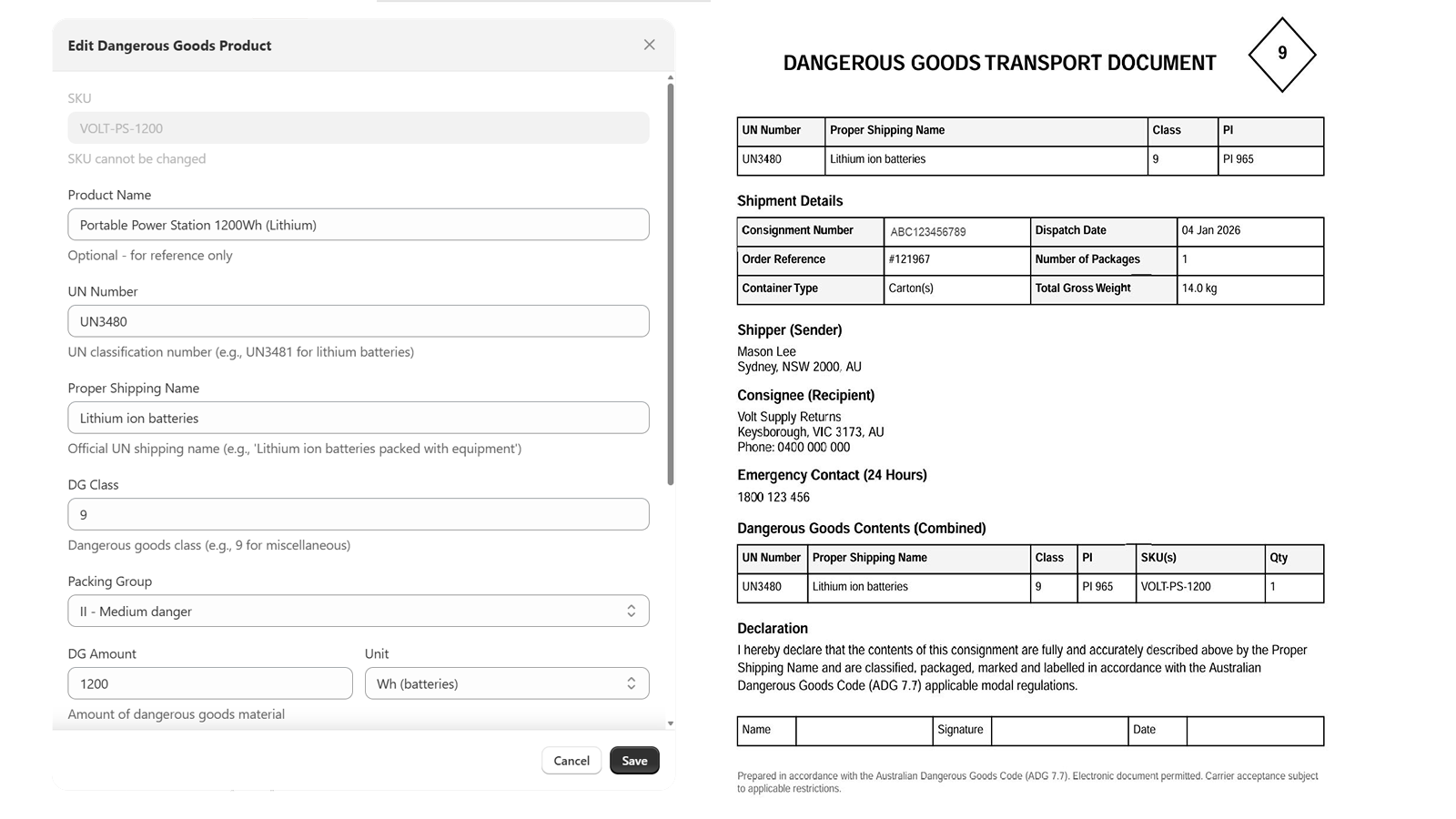
The stakes
Non-compliance is not an option.
Shipping dangerous goods without correct documentation carries serious regulatory consequences in every market — the ADG Code in Australia, 49 CFR in the United States, ADR across the UK and EU, TDG in Canada. If you process returns for lithium batteries, aerosols, power stations or e-bikes, every shipment has to be classified, documented and routed correctly.
Four checks. Every DG return. Automatic.
Auto-Detection
Products auto-classified by SKU matching against your DG product catalogue. No manual classification per RMA.
Transport Documents
Generated automatically with every DG return, in the framework that governs the shipment — Australian ADG 7.9, US DOT 49 CFR, UK & EU ADR, Canadian TDG, NZ Land Transport Rule, or IATA/IMDG.
Carrier Routing
Carriers that can't accept the hazard class in your market are filtered out at quote time — Australia Post in Australia, USPS in the US, Royal Mail in the UK — and the shipment routes to one that can, with DG surcharges applied. A DG-approved carrier account is still required on your side.
DG Surcharges
Percentage or fixed-amount surcharges applied transparently. Costs visible in the label generation modal.
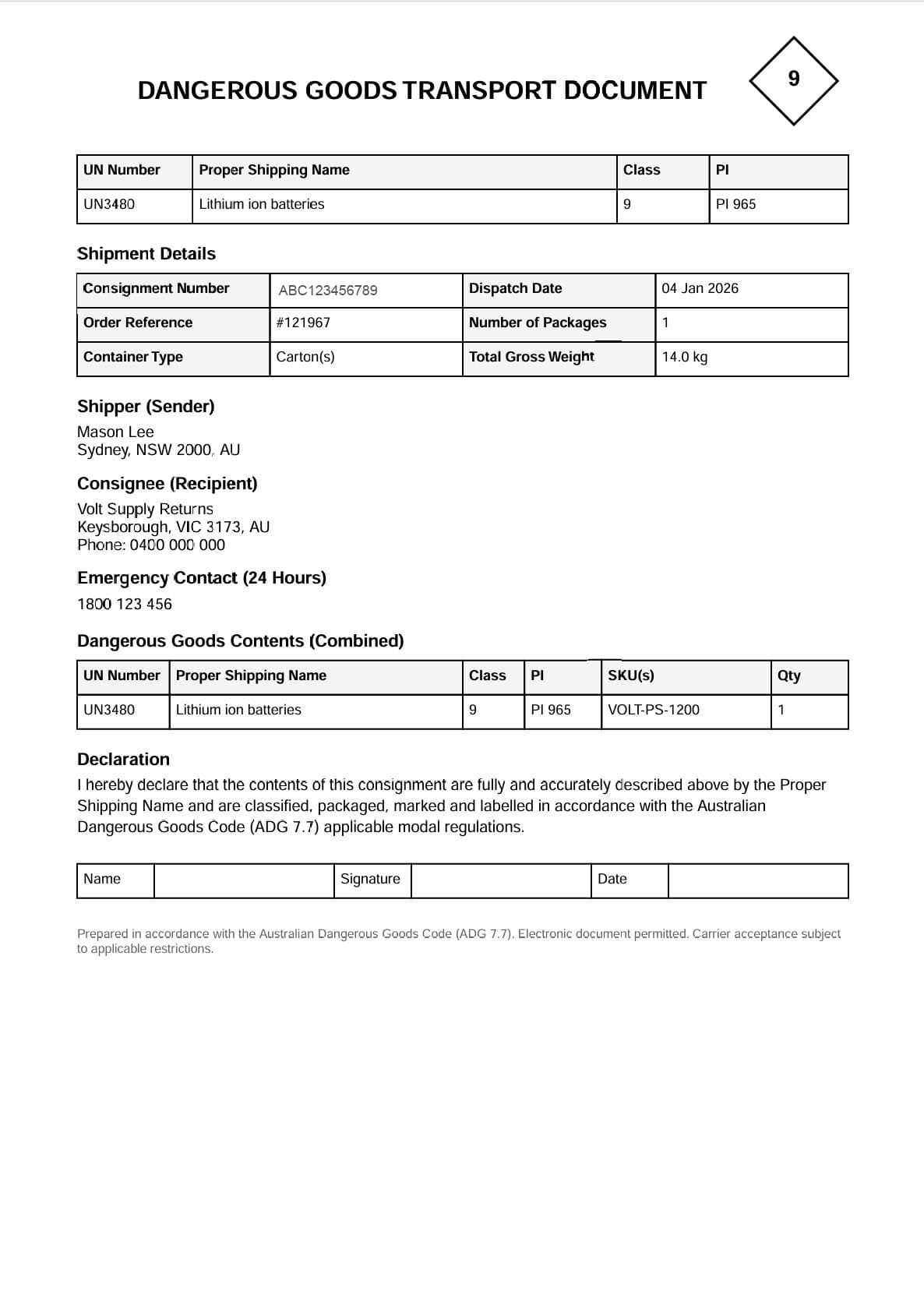
Auto-generated, regulator-ready.
The correct transport document for the shipment, generated automatically — no manual paperwork, no missed declarations, and no wrong-jurisdiction paperwork when you ship across borders.
- UN numbers, proper shipping names, class, and packing instructions
- Regulatory citation, certification wording, emergency contact and units all switch with the destination
- Shipper and consignee details auto-populated from RMA data
- Section I and Section II lithium battery support
- Attached to return label emails automatically
The right document for the country you ship in.
The transport document is selected automatically from the shipment's origin and destination — the regulatory citation, certification wording, emergency contact and units all change with it.
| Region | Framework | Status |
|---|---|---|
| Australia | ADG Code, Edition 7.9 | Automated |
| New Zealand | Land Transport Rule: Dangerous Goods 2005 | Automated |
| United States | US DOT 49 CFR 172.200–172.204 | Automated |
| Canada | TDG Regulations (SOR/2001-286) | Automated |
| UK & EU road | ADR (CDG 2009 / Directive 2008/68/EC) | Automated |
| International air & sea | IATA / IMDG | Automated |
Two notes on ADR. Particulars are produced in English. ADR 5.4.1.4.1 also requires an official language of the forwarding country where that is not English, so a domestic consignment forwarded from, say, France needs a French translation alongside the document. And the tunnel restriction code is printed only when it is recorded against the goods — it is never inferred from the UN number, because the correct code depends on the specific ADR Table A entry and its classification code.
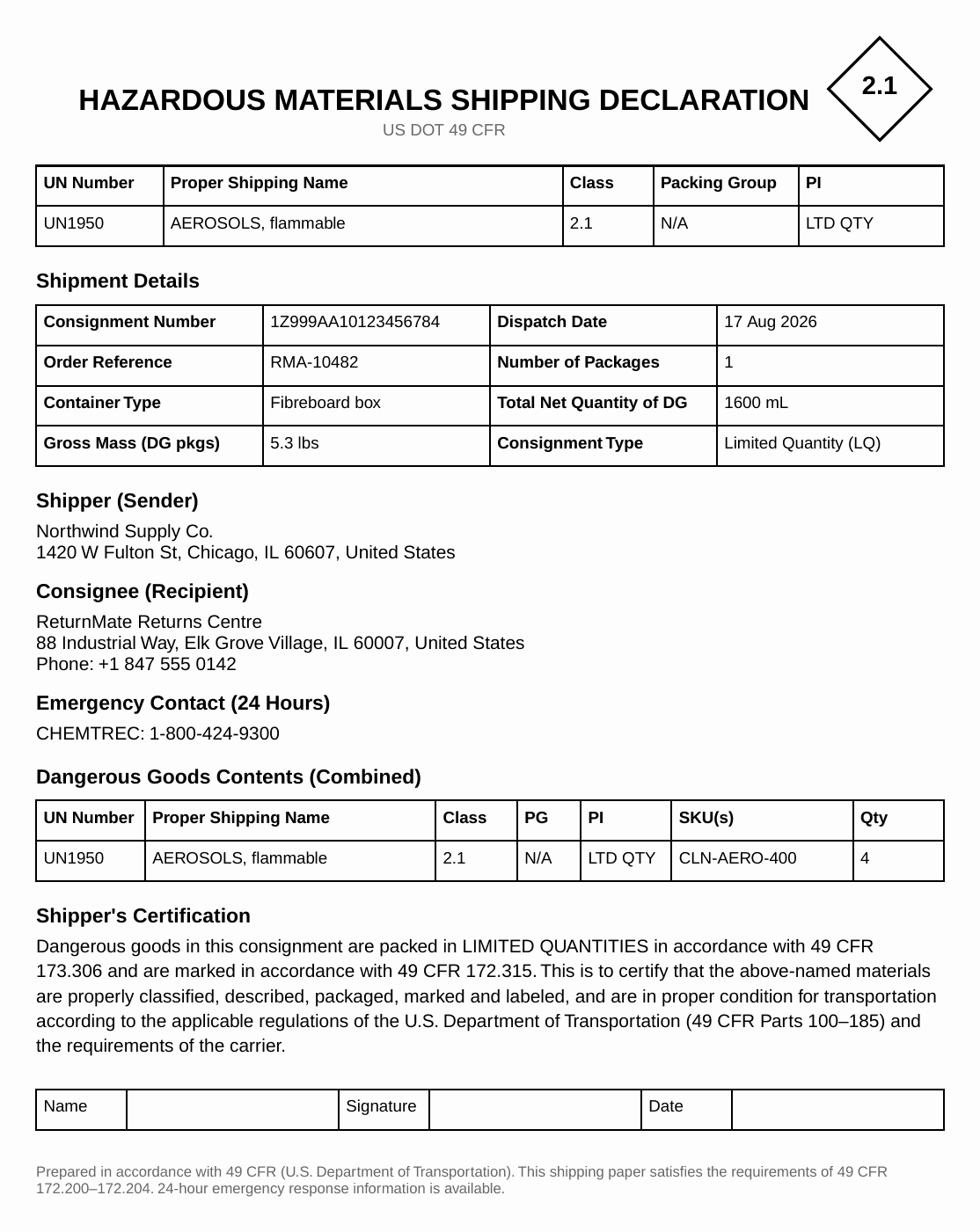
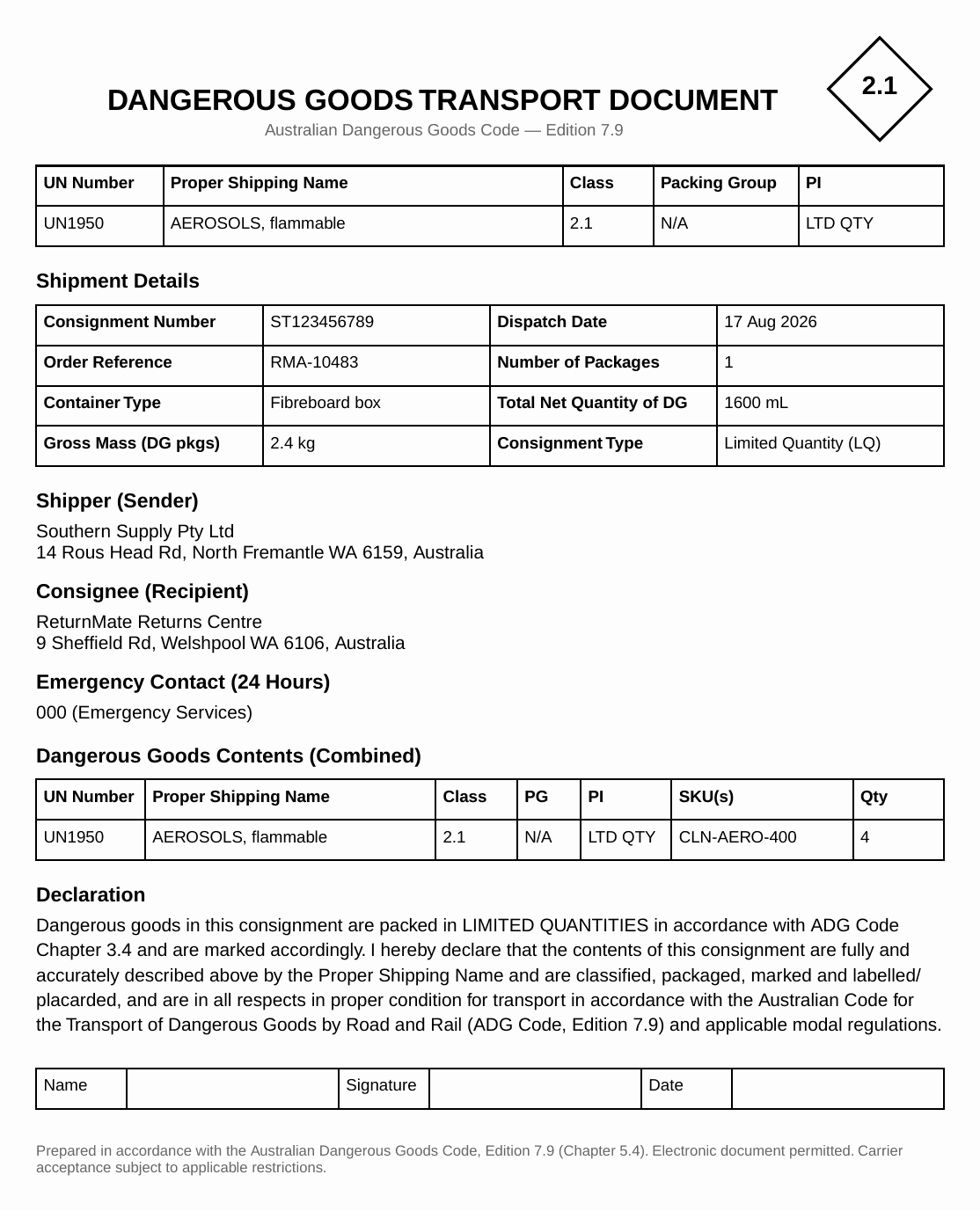
The same UN1950 aerosol consignment, documented for two jurisdictions. The regulatory citation, certification wording, emergency contact and units all change with the shipment.
Shipping in the United States
US domestic shipments produce a Hazardous Materials Shipping Declaration to 49 CFR 172.200–172.204, carrying your 24-hour emergency response contact, weights in pounds, and the DOT shipper's certification. Limited quantity consignments carry the statement that the goods are packed under 49 CFR 173.306 and marked per 172.315 — the provisions that apply to aerosols. ReturnMate produces the shipping paper; the package marking itself is applied by whoever packs the carton.
What stays with you
ReturnMate documents what you classify. Assigning the UN number, hazard class and packing group, determining whether a limited-quantity exception applies, physically marking the package, and hazmat training all remain the shipper's responsibility. We make the paperwork correct and consistent — we don't make the classification decision for you.
What's automated, precisely.
Compliance software that overstates its scope is worse than none, so here is the boundary in plain terms.
Transport documents
Automated, all five frameworks
The regulatory citation, certification wording, emergency contact and units are selected from the shipment. A US consignment cites 49 CFR 173.306 and 172.315; an Australian one cites ADG Chapter 3.4; a UK or EU one cites ADR Chapter 3.4.
Carrier routing
Automated, AU & NZ rule-based
Australia and New Zealand have carrier-specific DG rules — AusPost blocked, StarTrack or TNT selected by weight. Other markets route to a DG-capable carrier rather than a market-specific rule set.
Package marking
Not automated
Hazard labels and limited-quantity package markings are applied by you or your warehouse. ReturnMate produces the document and the shipping label, not the package marking.
Shipping dangerous goods in a market not listed here? Talk to us — we add jurisdictions in the order merchants actually need them.
Supported DG classifications.
ReturnMate supports any UN-classified dangerous goods. Configure custom UN numbers, proper shipping names, DG classes, and packing groups for your product catalogue.
| DG Class | Classification | Examples |
|---|---|---|
| Class 2.1 | Flammable Gases | Aerosol cans, camping gas, butane lighters |
| Class 2.2 | Non-Flammable Gases | CO2 cartridges, fire extinguishers, compressed air |
| Class 3 | Flammable Liquids | Solvents, adhesives, fuel-containing equipment |
| Class 4 | Flammable Solids | Matches, magnesium firestarters, self-heating products |
| Class 5 | Oxidising Substances | Pool chemicals, cleaning agents, bleach concentrates |
| Class 6 | Toxic Substances | Pesticides, certain cleaning products, medical reagents |
| Class 8 | Corrosives | Lead-acid batteries, acid-based cleaners, battery electrolyte |
| Class 9 | Miscellaneous | Lithium batteries (UN3480/3481/3090/3091), dry ice, magnetised material |

More on running post-sale operations.
Dangerous goods returns in Australia
Who counts as the consignor on a return, what the transport document has to say, and why damage changes the rules.
Shipping lithium batteries in Australia
UN3480 versus UN3481, the small-battery exception, state of charge, and why damaged cells are forbidden by air.
Returning a damaged e-bike battery
Recognising a swollen or heat-affected pack from the returns form, and the three lawful outcomes when it must not travel.
Caravan, camping and 4WD accessories
Lithium, gas cartridges and bullbars in one order, with the freight collection chosen by the customer.
Lithium batteries and power stations
UN3480 per SKU, return-to-depot routing and serialised warranty on the same RMA.
Guide to managing Shopify warranty claims
How to run a warranty claim in Shopify from intake to supplier credit, and what the workflow needs to cover.
RMA guide: return merchandise authorization explained
What an RMA is, how to process one, and when the number is worth printing on the label.
Ensure your returns are DG compliant.
Stop risking non-compliance. ReturnMate automates dangerous goods documentation for every return.