
What makes a dangerous goods return different
A forward shipment of dangerous goods is packed by someone who has been trained. They know the product, they have the classification on file, they have compliant packaging in stock, and they lodge with a carrier that has agreed to carry that hazard class. Every input is controlled.
A return inverts all of it. The item is packed by a customer, usually in whatever box the product arrived in, sometimes without the inner packaging that made the original shipment compliant. The customer cannot tell you the UN number. They may not know the item is regulated at all — most people do not think of a cordless drill, a camping stove or a bottle of drain cleaner as dangerous goods. And critically, the item may be returning precisely because it is damaged, which for several hazard classes changes the applicable rules entirely. Lithium batteries are the sharpest case and have their own guides: shipping lithium batteries in Australia covers the classification, and returning a damaged e-bike battery works through a swollen pack coming back from a customer.
The regulatory obligation does not soften to match. Under the Australian Code for the Transport of Dangerous Goods by Road and Rail — the ADG Code, Edition 7.9, mandatory since 1 October 2025 [1] — dangerous goods in transport must be correctly classified, packaged, marked, documented and carried by a vehicle and driver licensed for the load. Nothing in the Code says any of that relaxes because the consignment is travelling towards the merchant rather than away.
So the practical problem is not "how do I comply". It is "how do I comply when I do not control the packing, cannot see the item, and am relying on a description typed into a web form by someone with no reason to be precise".
Sending the customer a plain parcel label. If the item is regulated, a standard label routes it into a parcel network that is not licensed to carry it, and the consignment is either rejected at the depot or — worse — carried non-compliantly without anyone noticing until something goes wrong.
Who is the consignor on a return?
This is the question that decides where liability sits, and it is worth getting straight before you design the workflow.
In ADG terms the consignor is, broadly, the person who engages the carrier for the transport of the dangerous goods — the one whose name goes on the transport document and who is responsible for the consignment being correctly classified, packed, marked and documented. On a forward shipment that is unambiguously the merchant.
On a return it depends on how you set the movement up. If you generate the label, book the carrier and pay for the freight, you have engaged the carrier — and it is very difficult to argue you are not the consignor merely because someone else sealed the carton. If instead the customer takes the item to a carrier and lodges it themselves under their own account, they have engaged the carrier. In practice almost every ecommerce returns flow is the first case, because merchants send prepaid labels.
The consequence is that the merchant carries the documentation and classification obligation for a package they never touched. That is uncomfortable, and it is also the reason a dangerous goods return process deserves to be designed deliberately rather than inheriting the same flow as a t-shirt.
If you issue the label and pay the freight, assume the consignor obligations are yours
- Keep a record of what the customer was told to do, and what they confirmed
it is the only evidence you have about the state of the package
Do not rely on the customer's description as the classification; treat it as a trigger to apply the classification you already hold for that SKU
Where the item may be damaged, the classification you hold for a new unit may no longer be the right one
Classification should come from the SKU, not the customer
The only reliable way to classify a returning dangerous good is to have already classified it. You sold the item, so you know what it is: you can hold the UN number, proper shipping name, hazard class, subsidiary hazard, packing group and packing instruction against the SKU, once, and apply it automatically whenever a unit of that SKU comes back.
This is the single highest-leverage change most merchants can make. It moves classification from a per-return judgement call made by a customer service agent under time pressure to a per-product decision made once, deliberately, by whoever is competent to make it. It also means the answer is consistent: the same product returning from two customers on the same day produces the same classification and the same document.
What you need against each regulated SKU is modest, and it is the same data your forward shipping already depends on:
- UN number and proper shipping name
the basic description, in that order
Hazard class and any subsidiary hazard
Packing group, where one is assigned (lithium batteries are not assigned one)
- Net quantity of dangerous goods per unit, and its unit of measure
mass, volume, or watt-hours for batteries
Whether the item normally travels as a limited quantity, or under an excepted-quantity provision
Any special provisions and the emergency contact you want printed
The ADG transport document asks for the quantity of dangerous goods, not the weight of the parcel. On a mixed consignment those are very different numbers, and using the carrier-quoted package weight overstates the hazardous content — which is a documentation error, not a rounding issue.
Limited quantities matter more in reverse
The limited quantity provisions in ADG Chapter 3.4 [1] allow dangerous goods packed in small inner receptacles, within specified quantity limits per inner and per package, to travel with substantially reduced requirements. They are marked with the limited quantity mark rather than full hazard labels, and much of the placarding and documentation burden falls away.
For consumer products this is the normal case rather than the exception. A retail aerosol, a small bottle of adhesive, a household cleaning chemical — sold in retail sizes, these routinely fall inside limited quantity limits. Which means a large share of dangerous goods returns can, in principle, move as limited quantity.
The catch is that limited quantity status depends on the packaging, not just the contents. The relaxation applies to goods packed in accordance with Chapter 3.4 — appropriate inner receptacles, within the quantity limits, inside a sound outer package, marked correctly. A customer who throws a loose aerosol into a satchel has not produced a limited quantity consignment; they have produced a non-compliant one.
So the workflow question is whether you can get the customer to reproduce compliant packaging. Sometimes you can — if the item is returning in its original retail packaging inside its original carton, it is often already close. Sometimes you cannot, and the honest answer is that the item should not travel at all, or should travel under full requirements with a carrier who knows what is in the box.
What the transport document has to say
ADG Chapter 5.4 [1] sets out the particulars an ADG 7.9 transport document must carry, and on a return it is the core of the dangerous goods return documentation. The core of it is the basic description in a defined order — UN number, proper shipping name, hazard class with any subsidiary hazard in parentheses, packing group — plus the quantity of dangerous goods, the number and type of packages, the consignor and consignee, an emergency contact, and a declaration that the consignment is correctly classified, packed, marked and in proper condition for transport.
Two things about this are commonly misunderstood on returns.
The first is that an electronic document is acceptable. The Code does not require ink on paper; what it requires is that the information is available to the driver and to emergency services. In practice carriers usually want the document physically with the consignment, which for a return means the customer has to print it — and that is a real friction point worth designing around rather than discovering.
The second is that the document is jurisdiction-specific, and "jurisdiction" means the regime governing the movement, not where your business is registered. An Australian merchant whose US customer returns an item domestically inside the United States is looking at a movement governed by US DOT 49 CFR, not the ADG Code. A document citing ADG 7.9 for a road movement between two points in Texas asserts compliance with a regime that does not apply to it. As soon as you sell into more than one market, one document template stops being sufficient.
- United States
49 CFR 172.200–172.204 [2], with a shipper's certification and weights in pounds
- Canada
the Transportation of Dangerous Goods Regulations, SOR/2001-286 [3]
Dangerous goods transport document example
A dangerous goods transport document in Australia records the consignment’s dangerous-goods description, shipment details, consignor, consignee, emergency contact and declaration. This annotated example shows how that information appears on a ReturnMate-generated document for a return, including the product reference that ties it back to the SKU.
- 1Product reference SKU links the document to the product record.
- 2DG description Classification fields shown in this sample.
- 3Shipment details Reference, date, package count and gross weight.
- 4Sender and recipient Parties recorded for the return movement.
- 5Declaration Declaration text and completion fields.
Carrier acceptance is the hard constraint
You can classify perfectly and document perfectly and still be unable to move the item, because the carrier will not take it. Carrier acceptance is narrower than the regulations, and it is the constraint that actually shapes what is possible.
Two separate things are going on. The first is regulatory: a carrier needs the licensing, vehicle placarding and driver qualification to carry the load, which parcel networks generally do not have for fully regulated dangerous goods. The second is commercial: even carriers who can carry dangerous goods only do so for customers with an approved account, often approved per hazard class and sometimes per lane. A carrier having a hazmat programme nationally tells you nothing about whether your account is enabled for it.
Outside Australia the pattern is the same. In the United States, FedEx and UPS operate hazmat programmes and USPS is very restricted; in the UK and EU it is generally the international integrators rather than the domestic parcel networks.
The operational implication is that dangerous goods return shipping needs to be routed at the point the label is generated, not discovered at the depot. If the returns flow can offer the customer a carrier that cannot lawfully carry the item, it eventually will. That is the reason ReturnMate filters carrier services by hazard class and market before the customer sees a label.
Which couriers accept dangerous goods returns in Australia?
For anything beyond limited quantities, a dangerous goods courier in Australia generally means a freight service rather than a parcel network. StarTrack, TNT and Team Global Express carry dangerous goods freight by road. Australia Post’s tolerance is narrow and mostly confined to excepted and limited quantity lithium batteries contained in equipment, which rules it out for most fully regulated returns.
Whether any of them will accept a particular return depends on five things, none of which is the carrier’s national capability:
- Your account
DG acceptance is approved per merchant account, not switched on for every customer of the carrier
- The hazard class
an account approved for Class 9 lithium may not be approved for Class 2 aerosols or Class 3 flammable liquids
- The lane
approval is often granted per origin-destination pair, and a metro-to-metro lane may be accepted where a regional pickup is not
- The packaging
the carrier is accepting a package that meets its conditions, and a customer-packed carton without the original inners may not
- The item’s condition
a damaged, leaking or swollen item is a different transport proposition, and for damaged lithium batteries a different packing instruction altogether
When qualifying a carrier for DG returns, the question is not "do you carry Class 9" but "is our account approved to lodge Class 9 on this lane, and what documentation do you require at lodgement". The first question tends to get a yes.
Damaged and defective changes the rules
This is where dangerous goods returns diverge most sharply from forward shipping, and it is the part most likely to be missed, because it is counter-intuitive: the reason for the return can change the classification.
For several hazard classes, an item that is damaged, defective or leaking is not the same transport proposition as a sound one, and the provisions that apply to it are stricter. Lithium batteries are the clearest and most consequential example — damaged or defective cells and batteries are subject to their own special provision and packing instruction, and they are forbidden for transport by air altogether. A returns flow that treats "battery swelling" as an ordinary Class 9 return and puts it on an air service is not making a paperwork error. What that return should look like instead is worked through step by step in returning a damaged e-bike battery.
The practical response is to treat the return reason as a routing input. If the customer's stated reason indicates damage, leakage, overheating or physical deformation, that return should not follow the standard path. It needs either a different packing instruction and carrier, or a decision not to transport the item at all — which for low-value goods is frequently the right answer commercially as well as legally.
That last option deserves more attention than it gets. For a cheap regulated item, the cost of a compliant return leg routinely exceeds the value of the unit. Resolving the return without moving the goods — refund or replace, with the customer instructed to dispose of the item through an appropriate local channel — is a legitimate outcome and often the only sensible one. The requirement is that it is a deliberate decision recorded against the return, not an informal arrangement made over email by whoever picked up the ticket.
What to put in place
None of the above requires a large programme. The gap at most merchants is not sophistication, it is that dangerous goods returns run through the same path as everything else and depend on individual staff remembering that a given SKU is regulated. The list below is the process; ReturnMate’s dangerous-goods workflows are one way to run it, and the walkthrough that follows shows what it looks like in practice.
In rough order of value:
Classify every regulated SKU once, and store the classification against the product rather than deciding per return
- Make the returns portal recognise a regulated item and change what it asks for
photo evidence, condition questions, and the specific instructions that apply
Route the return reason: damage, leakage or overheating must not follow the ordinary path
Filter carriers by what they can lawfully and contractually carry for that hazard class in that market, at the point of quoting
Generate the transport document automatically from the stored classification, in the framework governing the movement
Give the customer the documents together with clear packing instructions, and accept that printing is a friction point to design for
- Keep the audit trail
classification applied, documents issued, what the customer confirmed, and who decided what
Have an explicit no-transport path for when the compliant answer is that the item should not move
Not in avoided fines, which are rare. It pays off in rejected consignments that never happen, customer service time not spent improvising a process, and being able to answer a carrier's compliance question in one minute rather than one afternoon.
How staff manage a dangerous-goods return in ReturnMate
The screens below come from one demo return, order #121967, a 1,200 Wh portable power station with SKU VOLT-PS-1200. It is the same return the annotated document above was generated for. Where a step involves both, staff decisions and automated actions are called out separately.
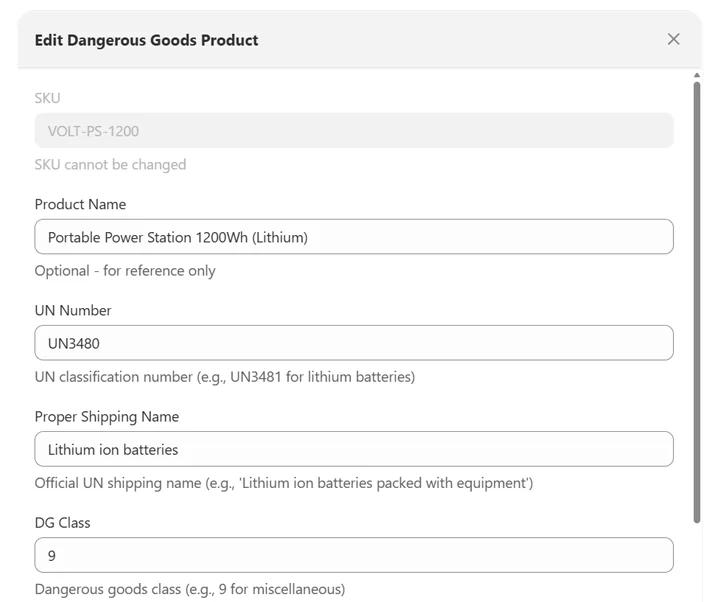
The product's dangerous-goods record is set once in the catalogue: UN number, proper shipping name, class, packing group and quantity. When the RMA is created, ReturnMate matches the SKU to that record and flags the line item with a DG badge automatically; nobody classifies per return. Staff then review what the customer submitted, the return reason, the description and the evidence photos, and decide whether the item should move at all. Damage, leakage or overheating is a staff call to take it off the ordinary path.
When staff approve the return and generate the label, ReturnMate offers only the carrier services that can carry the hazard class in that market. In Australia that removes Australia Post for dangerous goods and leaves the DG-capable services, with any DG surcharge you have configured shown in the label modal. Choosing the service is a staff decision. A filtered list is not carrier approval: DG acceptance is per account and often per class and lane, and staff confirm it with the carrier before the item moves.
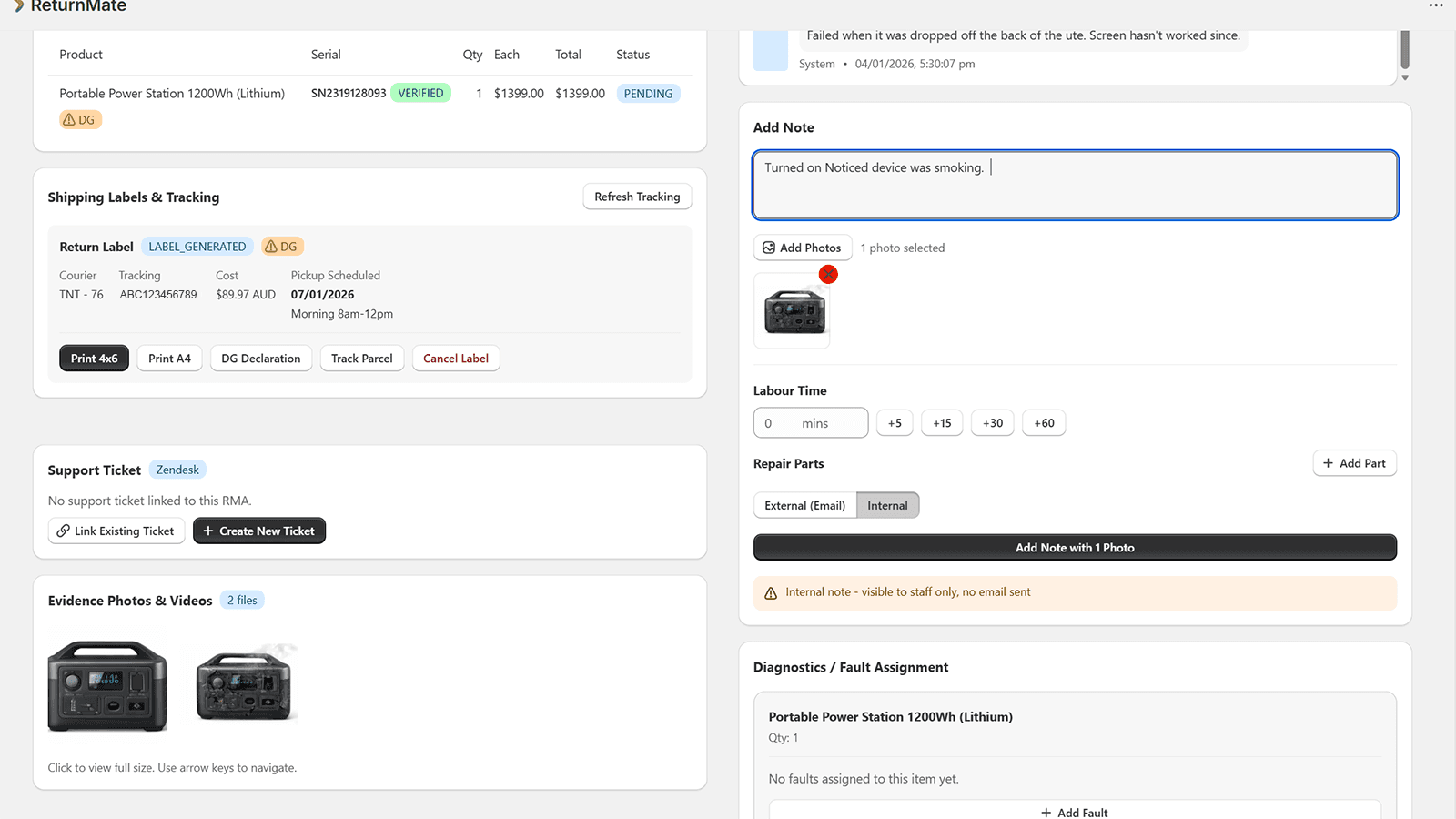
With the label, ReturnMate generates the dangerous goods transport document from the stored classification, in the framework governing the movement, and attaches it to the customer's label email. The document stays available from the RMA's shipping section for staff to download or reprint, alongside the label and tracking, so the record sits with the return. The customer prints both and packs the item; printing is the friction point to design for.
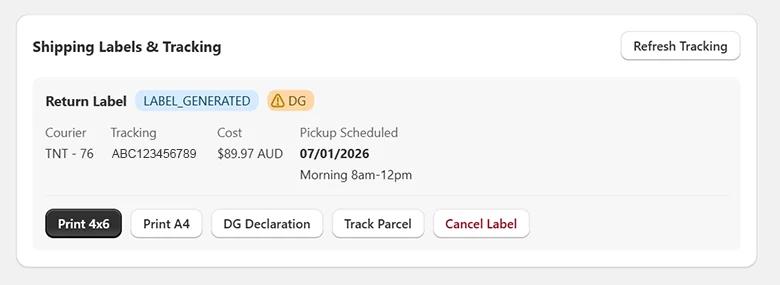
Generating a document does not itself establish that an item is safe or accepted for transport. Product condition, packaging, applicable requirements and carrier acceptance must also be checked.
See dangerous-goods returns in practice
Explore how ReturnMate connects product information, staff review, carrier selection and generated documents to the return record.
Frequently asked questions
Do dangerous goods rules apply to returns the same way as outbound shipments?
Yes. Nothing in the ADG Code relaxes classification, packaging, marking, documentation or carrier licensing because the consignment is travelling towards the merchant. What changes is practical rather than regulatory: the packing is done by an untrained member of the public, you cannot inspect the item first, and the goods may be damaged — which for some classes makes the applicable rules stricter, not looser.
Who is the consignor when a customer returns a dangerous good?
Generally whoever engages the carrier. If you issue a prepaid label, book the carrier and pay the freight — which is how almost every ecommerce returns flow works — it is very difficult to argue you are not the consignor merely because the customer sealed the carton. That means the classification and documentation obligations are yours for a package you never handled, which is exactly why DG returns need a deliberate process.
Can dangerous goods returns travel as limited quantities?
Often, and for retail-sized consumer products it is the normal case. But limited quantity status under ADG Chapter 3.4 depends on the packaging as well as the contents — appropriate inner receptacles, within the quantity limits, in a sound and correctly marked outer package. A customer who puts a loose aerosol in a satchel has not produced a limited quantity consignment. Whether you can rely on the provision comes down to whether you can get the original packaging reproduced.
Which carriers accept dangerous goods returns in Australia?
For anything beyond limited quantities it is generally freight rather than parcel — StarTrack, TNT and Team Global Express handle dangerous goods freight, while Australia Post's tolerance is narrow and mostly confined to excepted and limited quantity lithium in equipment. Two caveats: capability is not the same as approval, since carrier DG acceptance is per account and often per hazard class and lane; and the routing decision has to happen when the label is generated, not at the depot.
What if the returning item is damaged or leaking?
Treat it as a different transport proposition, because for several classes it is. Damaged or defective lithium batteries have their own special provision and packing instruction and are forbidden by air entirely. The return reason should therefore act as a routing input: damage, leakage or overheating must not follow the standard path. Sometimes the correct answer is that the goods do not travel at all, and the return is resolved with the item disposed of locally.
Do I need a paper transport document, or is electronic enough?
The ADG Code permits electronic documents — what it requires is that the information is available to the driver and emergency services. In practice carriers usually want the document physically with the consignment, which on a return means the customer has to print it. That is a genuine friction point in the returns flow and worth designing around explicitly rather than discovering when a consignment is rejected.
What happens if I sell into more than one country?
One document template stops being sufficient. The applicable framework follows the movement, not your place of business, so a domestic US return is governed by 49 CFR whatever your registered address is. A document citing ADG 7.9 for a road movement inside the United States asserts compliance with a regime that does not govern it — which is worse than a generic document, because it makes a specific claim that is wrong.
Sources
- National Transport Commission — Australian Dangerous Goods Code (Edition 7.9) — Chapter 3.4 (limited quantities) and Chapter 5.4 (documentation).
- eCFR — 49 CFR Part 172, Subpart C: shipping papers (§§ 172.200–172.204)
- Justice Laws Canada — Transportation of Dangerous Goods Regulations, SOR/2001-286
- legislation.gov.uk — Carriage of Dangerous Goods and Use of Transportable Pressure Equipment Regulations 2009 (SI 2009/1348)
- EUR-Lex — Directive 2008/68/EC on the inland transport of dangerous goods
- NZ Transport Agency — Land Transport Rule: Dangerous Goods 2005
- IATA — Dangerous Goods Regulations (DGR)
- IMO — International Maritime Dangerous Goods (IMDG) Code