
Returns and warranty software for caravan, camping and 4WD gear.
Hazardous, heavy and two metres wide, sold to someone a long way from your warehouse.
ReturnMate is returns, warranty and repair management software for Shopify merchants selling caravan, camping and 4WD accessories. It applies the lithium and gas profiles you configure per SKU, sizes freight for bullbars, fridges and rooftop tents from each product's real dimensions, lets the customer choose the pickup address, date and window once a return is approved, and then runs the warranty side: coverage check, technician diagnosis, paid repair quotes through Shopify checkout, and supplier returns with the credit tracked.
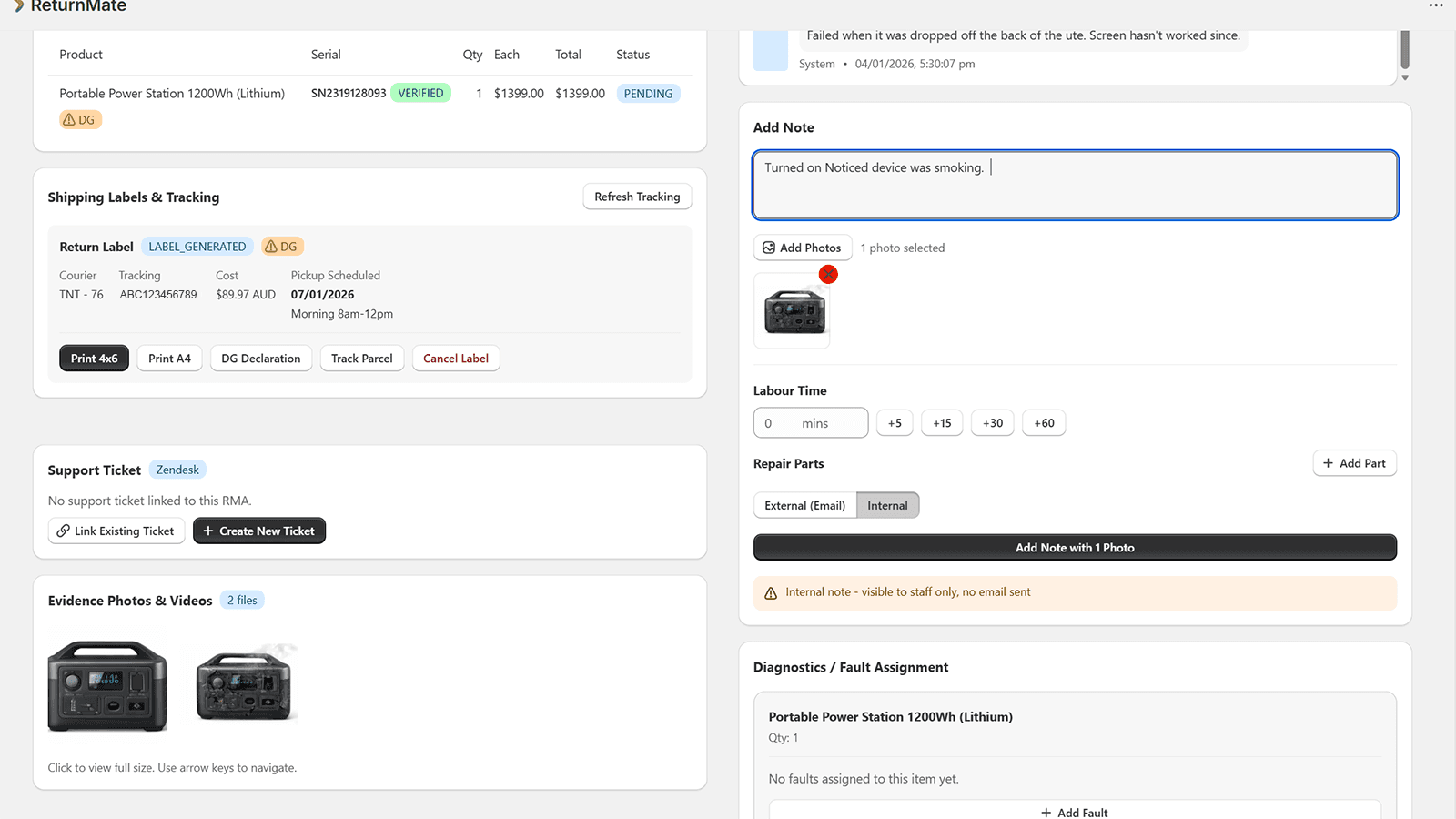
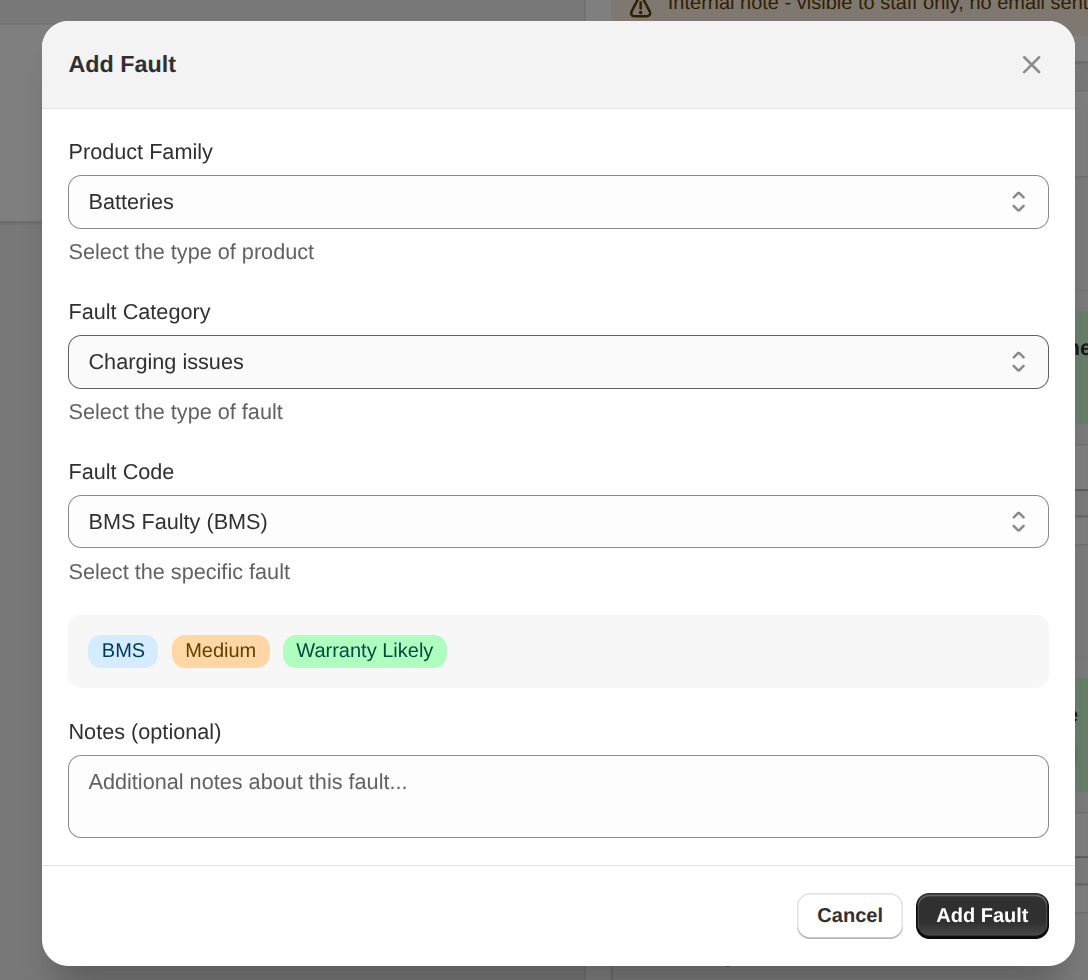
What the collection and the diagnosis look like on the record.
Two screens from ReturnMate, not mock-ups. The RMA on the left shows a TNT collection booked for a morning window with the DG declaration alongside the label; the right is the fault capture a technician completes before a warranty outcome is decided.
Four things a generic returns app gets wrong here.
Few categories put hazardous, heavy and long items in the same order the way this one does, or carry as much warranty exposure per unit. A satchel-first returns app leaves the classification and the freight to the operator, and the warranty claim to a spreadsheet.
Three hazard profiles in one order
A 12V lithium battery is UN3480, a jump starter is UN3481 and stove cartridges are UN2037 Class 2.1. Each needs its own profile applied and one document that lists all of them.
A bullbar is not a parcel
Steel bars run 55 to 90 kg and about 1.9 metres wide. Quoted against a default carton, the freight cost is wrong, the service is wrong, and the driver leaves without it.
The fault is often the supplier's
A failed battery management system on a 200Ah lithium or a compressor under warranty is the supplier's cost, if the fault is classified and the claim raised while the unit is still in your hands.
“Not cooling” is often not a fridge fault
A low-voltage cutout protecting a flat auxiliary battery presents as a dead fridge. Diagnosing that remotely is cheaper than collecting 30 kg to find nothing wrong.
- Bullbars and roof racks are vehicle-specific, so wrong-fit is a return reason that needs photos before a truck is sent
- Kits come back in several boxes and need one consignment, not five labels
- Fuel-powered gear has to be drained before collection, and the customer has to be told
- Where the customer is about to leave on a trip, replacing before the return arrives matters more than the refund
One order, three hazard profiles and a bullbar.
ReturnMate applies the dangerous goods profile and the dimensions configured on each SKU, filters carrier services to those set up for every class in the consignment, and prepares the transport document. Whether a particular returned item is fit to travel remains your team's decision, made from the evidence on the RMA.
Classification logic, transport documents and the full hazard-class coverage are detailed on dangerous goods handling; the shipper's-side practice is covered in shipping lithium batteries in Australia and dangerous goods returns in Australia. Carriers keep the shipper responsible for declaration, packaging and labelling, and TNT's dangerous goods guidance says so explicitly. ReturnMate prepares the documents and filters the services; it doesn't replace your own regulatory obligations or advice.
Three ways a battery claim can end.
A 200Ah lithium battery that stops charging is worth diagnosing. Refunded on the customer's word it is a write-off; diagnosed on the bench it is a supplier claim, or a paid repair if the coverage has lapsed. The figures are illustrative.
Illustrative figures. Coverage checks, diagnosis, labour and repair quotes are on warranty claims and repairs; claim packs and supplier credit reconciliation on fault tracking. On Scale and Enterprise plans, ERP integrations post the vendor credit when the claim resolves. The end-to-end process, from intake to supplier credit, is in our guide to managing Shopify warranty claims. Illustrative claim figures aside, every claim starts life as an RMA: see our guide to what an RMA is.
The bullbar that didn't fit.
An illustrative example, not a customer case. A wrong-fit bullbar carries a sizing question, an evidence question and a data question. Resolved on one record, the truck is booked once, from the right address, and the listing that caused the return gets fixed.
How does 68 kg and 1.9 metres come back?
Quoted against a default carton, the wrong service is booked and the driver leaves without it. Sized from the SKU, it is a freight consignment from the first quote.
Weight and dimensions on the product record; the quote and the consignment match the bar.
Is it actually the wrong part?
A truck to a fitter's workshop is expensive if the answer is a missing spacer. The return reason requires photos of the mounting points before approval.
Photos held on the RMA; approved once the mismatch is visible, then the customer chooses the pickup.
Why did it happen?
Third wrong-fit return on the same SKU this quarter. The listing did not distinguish the facelift, and the fault classification says so.
Return reasons clustered by SKU surface the listing error, not just the freight bill.
“Not cooling” is five different faults, and one of them isn't a fault.
Technicians classify against a taxonomy built for this category, so a low-voltage cutout is counted as no-fault-found rather than a compressor failure, and a real compressor batch problem surfaces while it is still a handful of units.
- Customer-reported symptom kept separate from the technician-confirmed fault
- No-fault-found measured per SKU, so a recurring cutout becomes a portal question rather than a freight bill
- Remote Resolve asks for the error code and supply voltage before anything is collected
- Battery and fridge serials recorded and verified against what was sold
- Failure rate measured against units sold, with a threshold you set per SKU
- Exportable evidence pack for a supplier or manufacturer claim
The reporting layer is on fault tracking; the repair workflow on warranty claims and repairs. The wider practice is covered in the product failure rate tracking guide.
Return methods the customer can choose.
Once a return is approved, the portal offers the methods the product profile allows. For a carrier collection the customer confirms the address, picks a date and requests a window, and ReturnMate books it from the availability the carrier reports.
Carrier pickup, customer-scheduled
The recommended carrier is offered with a pickup from the customer's address. They edit the address if the item is at a fitter or a caravan park, pick a date from the next business day onward, and choose a morning or afternoon window. With TNT the windows come from the carrier's reported availability for that postcode.
Drop off at a retail location
Free for the customer and receipted into the same RMA at the counter, with the item transferred to the site that can service it.
Prepaid parcel label
Offered only for what fits a parcel service: LED light bars, recovery straps, camp lighting. Filtered out by the product profile for dangerous goods and anything over the size or weight line.
- No same-day pickups are offered; a missed TNT pickup retries the next business day and a second miss raises a pickup-failed notification
- Kits return as one consignment with several packages rather than separate labels
- Per-product return instructions, such as draining fuel, appear before the pickup is booked
Method selection, pickup booking and evidence capture are described on the customer portal. Pickup windows and depot alternatives are on the TNT and Team Global Express integration pages.

Caravan, camping and 4WD returns questions.
Can the customer book the carrier pickup themselves?
Yes. Once the return is approved, the portal asks the customer to choose a return method: drop off at one of your retail locations, arrange their own courier at their own cost, or ship with the recommended carrier, which schedules a pickup from their address. For a carrier pickup they confirm or edit the pickup address, pick a date from the next business day onward, and choose a morning or afternoon window. With TNT the windows shown are the carrier's reported availability for that postcode over the next five business days. If a TNT pickup is missed, the carrier retries the next business day; a second miss raises a pickup-failed notification so staff can re-book or switch the customer to depot drop-off.
How does a bullbar come back?
As freight, sized from the product record rather than a default carton. Each SKU holds its weight and dimensions, so a 68 kg steel bar that is 1.9 metres wide is quoted and consigned as exactly that. The pickup address in the portal is editable, so the customer can have it collected from the fitter's workshop rather than their home.
Can one return hold a battery, a gas stove and a fridge?
Yes. Each item on the RMA carries its own dangerous goods profile and disposition. The battery is classified UN3480, the stove cartridges UN2037, and the fridge is bulky but not hazardous. Carrier services are filtered to those configured for every class in the consignment, and the transport document lists what is in it. Whether a particular returned item is fit to travel, such as a battery that has been dropped, is still a decision your team makes from the photos and notes on the RMA.
Can a lithium battery, a fridge and a bullbar carry different warranty terms?
Yes. Warranty policies attach by product, SKU, tag or collection, so a five-year term on LiFePO4 batteries, a two-year term on fridges and a separate term on bars and racks coexist in one store. Coverage is calculated from the Shopify purchase date or a supplied proof of purchase and written to the RMA. Terms apply per product, not per component within a product.
Can we claim a failed battery or compressor back from the supplier?
Yes. The technician's confirmed fault, the serial and the photos export as a claim pack, and a supplier return is its own workflow on the RMA with the supplier's RA number and return tracking recorded. Warranty-likely faults can be marked with the supplier so the credit is reconciled rather than forgotten. On Scale and Enterprise plans the ERP integration posts vendor credits for supplier-responsible warranty cost.
Can we quote and charge for out-of-warranty repairs?
Yes. After inspection the technician raises a quote for labour and parts, the customer pays it through Shopify checkout, and the job proceeds on approval. Quotes carry an expiry and a decline path, so a fridge nobody wants to pay to fix does not sit on the bench indefinitely.
A fridge comes back as not cooling and nothing is wrong with it. Can that be avoided?
Often. A low-voltage cutout protecting a flat auxiliary battery presents as a dead fridge. Configure the return reason to require photos and use Remote Resolve to ask for the error code and supply voltage before anything is collected. When the unit does come back, the technician records the confirmed fault separately from the reported symptom, so no-fault-found is measured rather than argued.
The customer leaves on a trip on Friday. Can we replace before the faulty unit is back?
Yes. Replace in Transit ships the replacement before the return arrives, with the original still tracked on the same RMA. It suits the case where the customer is about to leave and a return-then-replace cycle would miss the trip.
Do generators and fuel-powered gear need special handling?
The product record can carry special return instructions, such as draining and purging fuel before collection, and the portal shows them to the customer before the pickup is booked. The instruction lives on the product, so every return of that SKU carries it.
Can technicians work the returns on a device rather than a desk?
Yes. ReturnMate Tech, our technician app, is on the App Store and Google Play. It opens the right job from a device tag, QR code or carrier label and records the fault classification, findings, photos, serial verification, labour minutes and parts consumed, writing to the same RMA the office team sees.
How much does ReturnMate cost?
ReturnMate has a Free plan at US$0/month including 5 RMAs. Starter is US$49/month for up to 50 RMAs, with Growth, Ops, Scale and Enterprise plans available for larger operations. Full details are on the pricing page at returnmate.io/pricing.
Related capabilities.
Coverage, diagnosis, parts and paid repairs.
The workshop workflow behind every claim on this page, through to the supplier credit.
Read more →§ CUSTOMER PORTALReturn method, pickup address, date and window.
The self-service flow behind every collection on this page, gated by product profile before the customer sees an option.
Read more →See the whole post-sale workflow on your own catalogue.
Classification, freight sizing, customer-chosen collections, warranty diagnosis, repair quotes and supplier recovery, running on your products. Install free from the Shopify App Store or book a demo. Billed through Shopify, cancel from inside Shopify.