
Returns and warranty software for tools and industrial equipment.
Trade customers don't want a refund. They want the tool working — and a date.
ReturnMate is returns, warranty and repair management software for Shopify merchants selling tools and industrial equipment. It handles a kit as one record with a disposition per item, carries the battery's dangerous goods profile inside an ordinary-looking return, tracks bench repairs with labour and parts, sells out-of-warranty work through Shopify checkout, and attributes repeat component failures to the supplier's production run.
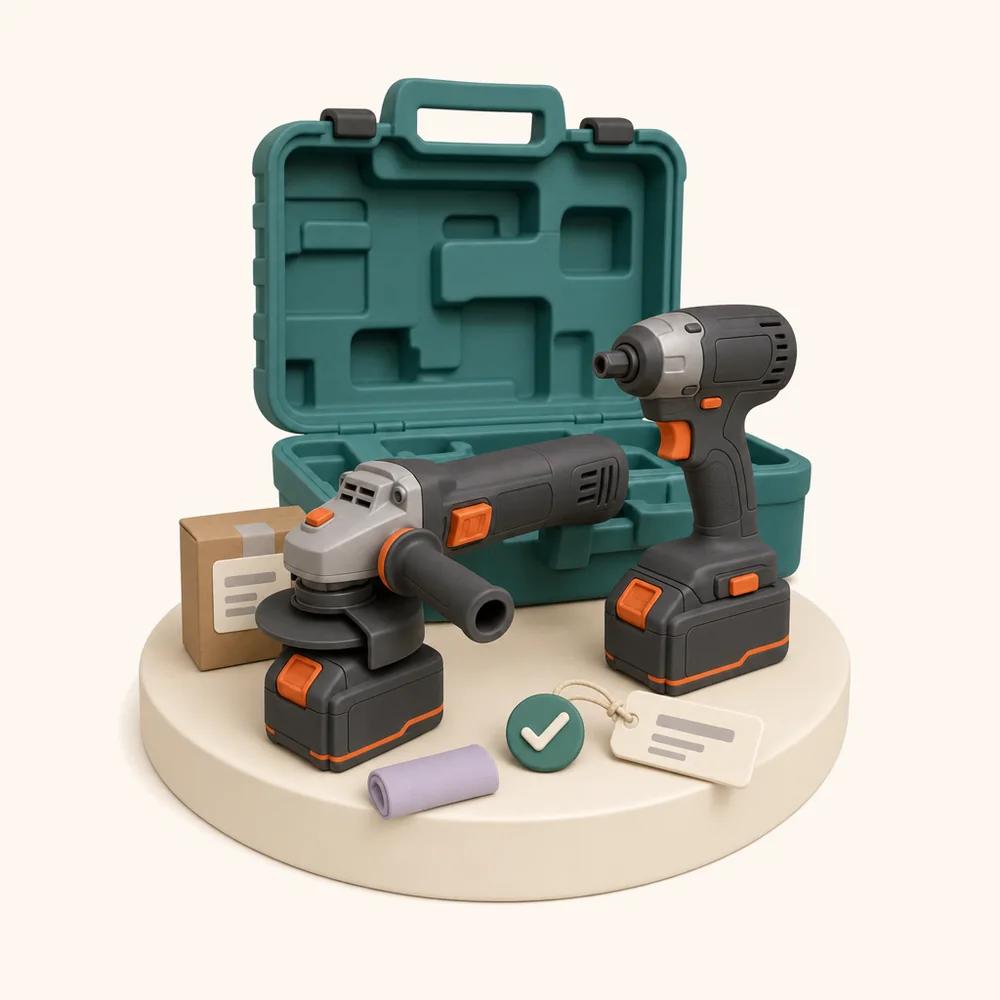
Four things a generic returns app gets wrong here.
Returns tooling models one item, one reason, one outcome. Industrial equipment comes back as a kit — one customer conversation carrying several inventory decisions, a hidden dangerous good and a customer whose livelihood is waiting on the answer.
One box, several decisions
The tool, a battery, a charger and a case — and usually only one of them has failed. A one-line return forces your team to split it into tickets, or lose the detail.
The whole kit isn't faulty
Sending the complete kit back to the supplier surrenders stock you could sell. Only the failed component should move on; the rest restocks.
There's a battery in there
The kit looks like an ordinary parcel, but the battery inside is a Class 9 dangerous good with its own transport rules on the return leg.
Downtime is the customer's cost
A tradesperson without their driver is losing money daily. Without labour and parts tracked, “when will it be ready” has no honest answer.
- Repeat failures on a SKU are a supplier problem, not a returns problem
- Trade accounts expect counter service, not an RMA queue
- Heavier consignments belong on freight services, not parcel post
- Out-of-warranty work is repair revenue if you can quote it and get paid
Four items. Four different answers.
This is what a multi-part RMA exists for. The customer reports one problem; the record carries a disposition per item, so each part of the kit takes its own correct path without the conversation splitting into four tickets.
- Per-item dispositions: restock, workshop, supplier return, disposal or quarantine
- The battery's DG profile travels with it even when it came back inside a kit
- No-fault-found recorded per item, so quality data stays built on confirmed faults
- Serial numbers verified per component where the SKU requires them
From “it stops under load” to a supplier credit.
The same claim carries a triage question, a service commitment and an accountability question. Handled as one record, the third one stops being impossible to answer.
Which part actually failed?
Four items came back; one is faulty. The driver goes to the bench, the battery keeps its DG profile, the charger tests clean, the case restocks.
Per-item dispositions on one record — the rest of the kit goes back to stock.
When does the customer get it back?
A trade customer is losing money without the tool. Labour and parts are logged as the repair happens, so the answer is grounded in the job, not a guess.
Bench progress, labour minutes and parts on the RMA the counter team can see.
Whose defect is this?
Ninth confirmed trigger-switch failure from one production run — a component problem, not how the customer treated it.
Fault, serial and batch clustered into an exportable supplier claim pack.
“It stopped working” is not a diagnosis.
Technicians classify against a taxonomy built for this category, so a component-level pattern surfaces while it's still nine units — and while the supplier conversation is still winnable.
- Customer-reported symptom kept separate from the technician-confirmed fault
- Failure rate measured against units sold, with a threshold you set per SKU
- Batch clustering separates a bad production run from a bad design
- Defect rates aggregate by supplier, so the claim is a rate rather than a complaint
- Average repair cost and labour reported by product and fault type
- Exportable evidence pack for a supplier or manufacturer claim
The reporting layer is on fault tracking; the repair workflow on warranty claims and repairs. The wider practice is covered in our guide to managing Shopify warranty claims. The counter and bench side of paid repairs is in our repair management guide for Shopify merchants.
How a trade customer gets served.
A returns queue is the wrong shape for a customer standing at the counter with a dead tool. The workflows here exist so the trade account is looked after immediately — and the faulty unit still enters the pipeline properly.
Counter Swap
Credit issued, replacement order created and inventory moved in one action at the register. The faulty unit enters the repair pipeline without a ticket being raised.
Paid out-of-warranty repair
Quoted from your labour rate and real parts cost after inspection, paid through Shopify checkout, back into the technician queue when payment clears.
Freight when it's heavy
Heavier consignments route to Team Global Express, Mainfreight or TNT rather than a parcel service — and a kit battery inherits Class 9 routing automatically.
- Third-party repairs accepted as TPR-prefixed RMAs — a service line, not an exception
- Technicians work the queue from ReturnMate Tech on the bench
- Per-stage SLA monitoring flags a stalled repair before the trade customer calls
- Multi-location retailers route the unit to whichever site holds the parts
Counter Swap and the other workflow types are on RMA management; battery handling is on dangerous goods.

Tool and equipment returns questions.
Can one RMA cover a tool kit with several items?
Yes. A kit can come back as one record with a disposition per item, so the failed component can go to the bench or the supplier while the rest is restocked, without splitting the customer's return into several tickets. Only the part that actually failed moves on; everything else is graded and goes back to stock.
What if the kit contains a lithium battery?
The dangerous goods profile is set per SKU, so a battery in the kit carries its own UN number and class. The consignment routes to a DG-capable carrier and the transport document reflects what is actually in the box — the battery doesn't quietly travel on a non-DG service because it arrived inside an ordinary-looking kit.
Can trade customers be served at the counter?
Yes. Counter Swap issues the credit, creates the replacement order and moves the inventory in one action at the register, so a trade customer is back on the job the same day — and the faulty unit still enters the repair pipeline properly rather than sitting in a corner.
Can we track technician time and parts against a repair?
Yes. Labour is logged in minutes against your configured rate, parts are consumed at cost, and each job carries a total cost to repair. That's what lets you tell a trade customer when the tool will be ready, and see what the repair actually cost you.
Can we charge for out-of-warranty tool repairs?
Yes. After inspection you build a repair quote from your labour rate and real parts cost, and the customer pays through a Shopify checkout link. When payment clears the job returns to the technician queue. Quotes carry an expiry, and declined quotes route to return-as-is or disposal with the decision logged.
Can we repair tools the customer bought elsewhere?
Yes. Third-party repairs are raised as TPR-prefixed RMAs, deliberately separate from your own sales, with no refund or store-credit path exposed on an item you never sold. For a trade-focused workshop that's a service line, not an exception.
How do we get money back from suppliers?
Fault codes attribute to the supplier's SKU, so defect rates aggregate over time and the claim data exports. Nine trigger-switch failures from one production run is a credit conversation with evidence — you are presenting a rate, not a complaint.
Can technicians work jobs from the bench?
Yes. ReturnMate Tech, our technician app (on the App Store and Google Play), opens the right job from a device tag, QR code or carrier label and records the fault classification, diagnostic findings, photos, serial verification, labour minutes and parts consumed — writing to the same RMA the counter and office teams are looking at.
How much does ReturnMate cost?
ReturnMate has a Free plan at US$0/month including 5 RMAs. Starter is US$49/month for up to 50 RMAs, with Growth, Ops, Scale and Enterprise plans available for larger operations. Full details are on the pricing page at returnmate.io/pricing.
Related capabilities.
Coverage, diagnosis, parts and paid repairs.
The bench workflow behind every claim on this page, through to supplier recovery.
Read more →§ FAULT TRACKINGFailure rates, batch tracing, supplier claims.
Where nine trigger-switch failures become a threshold alert and an evidenced credit.
Read more →Stop refunding kits when one part failed.
See per-item dispositions, bench repairs and supplier recovery running on your own catalogue. Billed through Shopify, cancel from inside Shopify.