
Returns and warranty software for e-bikes and mobility products.
A Class 9 dangerous good, bolted to a freight problem.
ReturnMate is returns, warranty and repair management software for Shopify merchants selling e-bikes and mobility products. It classifies the return as UN3481 lithium-in-equipment from the product profile, routes anything over the parcel weight line to DG-capable road freight, lets the battery come back on its own when the frame doesn't need to move, verifies frame, battery and motor serials, and traces cell failures back to the supplier batch that caused them.
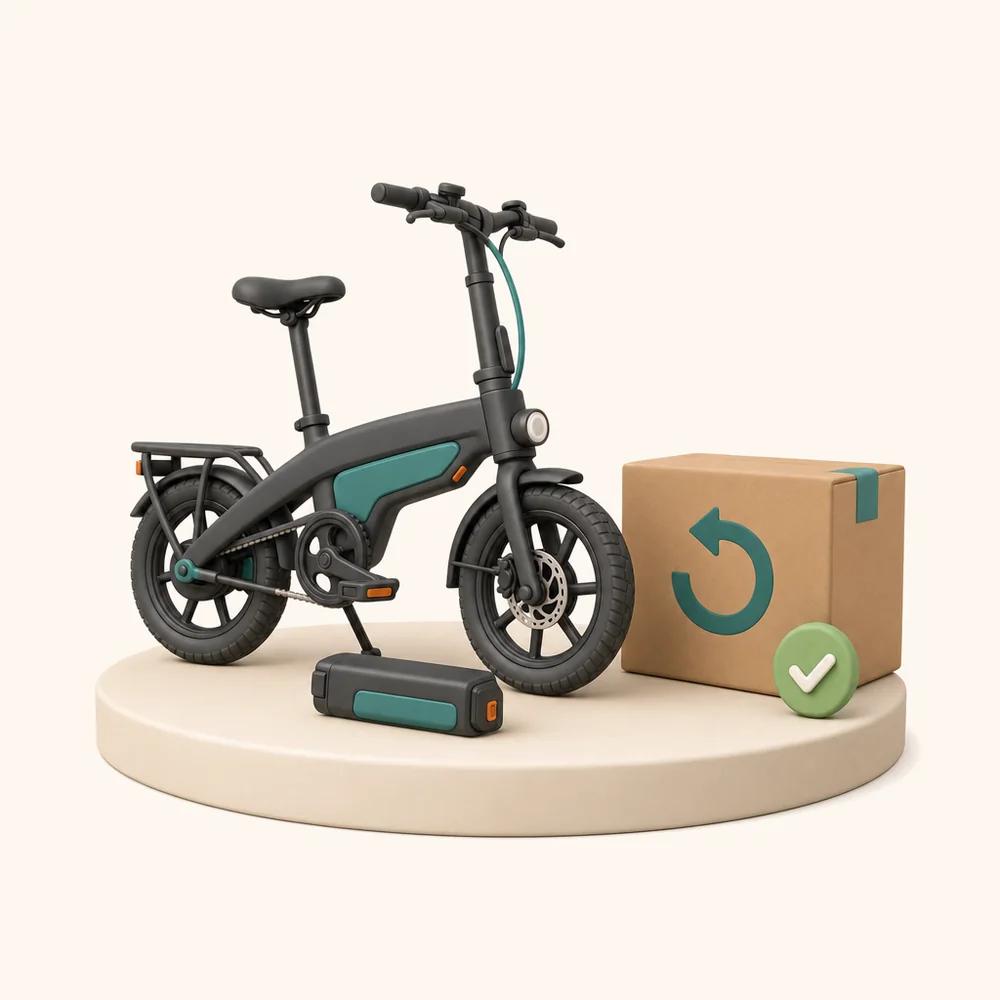
Four things a generic returns app gets wrong here.
Lithium restricts which carriers can take it. Size and weight restrict it further. The intersection is a very short list of services — and picking one by hand every time is how non-compliant shipments happen.
Class 9 excludes parcel post
The battery makes the whole consignment a dangerous goods movement. Standard parcel services are out before weight is even considered.
The frame is freight regardless
At 20–35kg with awkward dimensions, an e-bike exceeds parcel limits on its own. The carrier list that satisfies both constraints is very short.
The battery can travel alone
Most battery faults don't need the frame back. Shipping thirty kilos to inspect a two-kilo battery is the category's most avoidable cost.
Three serials decide the warranty
Frame, battery and motor each carry a serial — and often different warranty terms. Without verification, out-of-term claims get paid.
- A transport document is required for the lithium regardless of the freight arrangement
- A swollen or heat-affected battery changes how — and whether — it can move at all
- The customer can rarely box an e-bike, so depot drop-off and collection matter
- Freight legs are slow, so a stalled return needs to surface before the customer calls
Where lithium and freight intersect.
Because the dangerous goods profile is per SKU and the routing rules consider weight, an e-bike return resolves to a compliant service without an operator making the call — and the battery keeps its own profile when it travels alone.
Classification logic, transport documents and the full hazard-class coverage are detailed on dangerous goods handling; the shipper's-side practice is covered in shipping lithium batteries in Australia, and the case where the pack comes back swollen or heat-affected in returning a damaged e-bike battery. ReturnMate supports the compliance workflow — it doesn't replace your own regulatory obligations or advice.
The claim where the bike never moves.
The same claim carries a classification question, a freight decision and an accountability question. Resolved together on one record, the answer is often that only the battery travels — which is the cheapest possible version of this return.
What is actually being shipped?
A battery on its own is UN3480, not UN3481 — a different classification with different paperwork. Getting that wrong is how consignments get refused.
Classified per item from the product profile; the document matches what's in the box.
Does the whole bike need to move?
A 28kg freight booking to inspect a 3.4kg battery is money spent on nothing. The fault pattern says battery — so only the battery is asked for.
Battery-only return raised as its own item, so nothing freight-sized moves for a battery fault.
Whose defect is this?
Sixth confirmed cell-imbalance failure from one cell batch this quarter. That's a manufacturing problem with a supplier's name on it.
Fault, serial and batch clustered into an exportable supplier claim pack.
“Cuts out” is five different faults.
Technicians classify against a taxonomy built for this category, so a cell-batch pattern surfaces while it's still six units — and the frame-versus-battery-versus-motor question is answered by data rather than argument.
- Customer-reported symptom kept separate from the technician-confirmed fault
- Frame, battery and motor serials recorded and verified against what was sold
- Thermal and swelling events recorded at the highest severity and alerted immediately
- Failure rate measured against units sold, with a threshold you set per SKU
- Batch clustering separates a bad cell run from a bad design
- Exportable evidence pack for a supplier or manufacturer claim
The reporting layer is on fault tracking; the repair workflow on warranty claims and repairs. The wider practice is covered in the product failure rate tracking guide and the guide to managing Shopify warranty claims, and choosing a system for long warranty terms in our warranty management software guide.
What the customer is allowed to choose.
The portal decides the return method from the product profile, before the customer sees an option. Nobody gets offered a satchel label for an e-bike — and nobody freights a whole bike for a battery fault.
Battery-only return
The battery comes back as its own item with its own UN3480 profile — a small DG consignment instead of a freight booking.
DG road freight for the bike
Booked collection with the correct paperwork generated with the consignment, when the frame genuinely has to come back.
Prepaid parcel label
Never offered for this category — excluded by hazard class and weight together, suppressed by the product profile.
- Depot or store drop-off where the customer is local and the unit can be walked in
- Per-stage SLA monitoring flags a return sitting at a freight depot before the customer escalates
- Multi-location retailers route the unit to the site that can actually service it
- Condition captured at receiving, on a unit that may have travelled badly
Method selection, eligibility gating and evidence capture are described on the customer portal. Receiving and quarantine on arrival are on receiving.

E-bike returns questions.
Can the battery be returned separately from the bike?
Yes, as separate RMAs or separate items on one, each with its own dangerous goods profile and disposition. That matters because the battery and the frame often need different services and different destinations — and for most battery faults it means nothing freight-sized has to move at all.
How is the correct carrier chosen for an e-bike return?
Rules consider the hazard class and the weight together. In Australia that excludes Australia Post for DG and sends anything over 22kg to TNT Road Express or Mainfreight rather than a parcel service. You are not relying on an operator remembering either constraint.
What about state of charge before shipping?
There is no state-of-charge field. Configure the DG return reason to require photos and use an email template to ask the customer to confirm the charge is below 30% before you approve — the confirmation is held on the RMA as correspondence rather than as structured data.
What happens if a battery comes back swollen or heat-affected?
It's treated as a safety-relevant fault at the highest severity, flagged before the parcel is opened, and routed to segregated receiving rather than the general packing bench. It's held rather than automatically consigned onward, and where the unit can't safely move again the disposal path is recorded against the RMA.
How are frame, battery and motor serials handled?
All three are captured and verified — at claim time and again when the unit or component is received. Serial uniqueness across active RMAs stops the same device being claimed twice, and prior repairs on the same serial are visible to the technician, which is what protects you on a high-value warranty decision.
Can frame, battery and motor carry different warranty terms?
Yes. Warranty policies attach by product, SKU, tag or collection, so a five-year frame term, a two-year battery term and a two-year motor term coexist in one store. Coverage is calculated from the Shopify purchase date or a supplied proof of purchase, and the determination is written to the RMA.
Can we track SLA on slow freight returns?
Yes. Per-stage SLA monitoring with breach notifications means a return sitting at a depot surfaces before the customer escalates — which matters more here than anywhere, because freight legs are the slow part of every e-bike claim.
Can technicians diagnose e-bikes on the workshop floor?
Yes. ReturnMate Tech, our technician app (on the App Store and Google Play), opens the right job from a device tag, QR code or carrier label and records the fault classification, diagnostic findings, photos, serial verification, labour minutes and parts consumed — writing to the same RMA the office team is looking at.
How much does ReturnMate cost?
ReturnMate has a Free plan at US$0/month including 5 RMAs. Starter is US$49/month for up to 50 RMAs, with Growth, Ops, Scale and Enterprise plans available for larger operations. Full details are on the pricing page at returnmate.io/pricing.
Related capabilities.
Classification, documents and carrier filtering.
Every hazard class you ship, resolved at label time rather than argued at the depot.
Read more →§ WARRANTY & REPAIRSCoverage, diagnosis, parts and paid repairs.
The workshop workflow behind every claim on this page, through to supplier recovery.
Read more →Stop freighting thirty kilos to fix a battery fault.
See compliant routing, battery-only returns and supplier recovery running on your own catalogue. Billed through Shopify, cancel from inside Shopify.